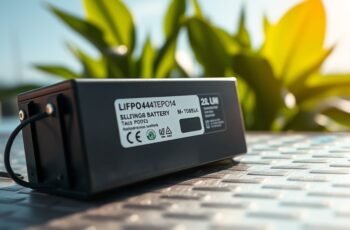
Choosing the wrong LiFePO4 battery size can instantly compromise your entire off-grid system, leading to inefficient energy use or costly failures. It’s critical to precisely match your power needs with the right capacity and voltage to guarantee reliability and longevity. But determining these specifications isn’t straightforward, and small mistakes can have significant consequences. Understanding the fundamentals of sizing your battery bank can save you time, money, and frustration—so let’s explore how to do it correctly.
Key Takeaways
- Calculate total daily energy consumption of all devices to determine required battery capacity.
- Match battery voltage and capacity with inverter and charger specifications for compatibility.
- Consider future expansion needs to size batteries that accommodate increased energy demands.
- Avoid undersizing batteries to prevent system strain and reduce lifespan.
- Regularly monitor voltage, temperature, and state of charge to maintain optimal battery health and longevity.
Why Choosing the Right LiFePO4 Battery Size Matters for Off-Grid Power
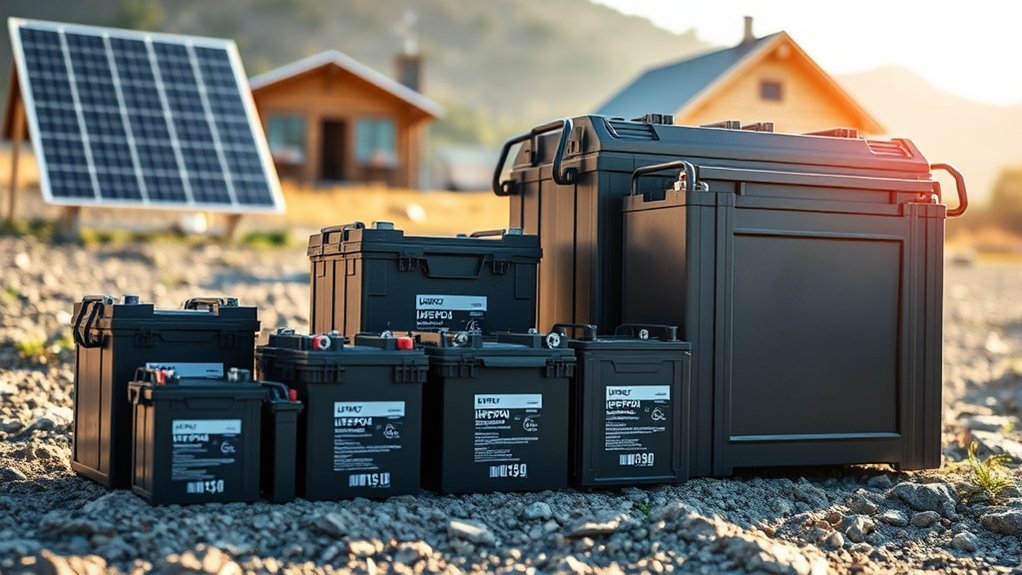
Have you ever considered how the size of your LiFePO4 battery directly impacts the reliability and efficiency of your off-grid power system? The choice of battery size hinges on understanding its chemistry—LiFePO4 offers high stability and cycle life, making it ideal for sustained use. An appropriately sized battery guarantees it can handle the load without overtaxing its capacity, which is vital for maintaining peak performance. Furthermore, proper sizing aligns with suitable charging methods, preventing under- or overcharging that can degrade the battery’s lifespan. Larger batteries provide greater reserve capacity, reducing the risk of power shortages, while smaller ones optimize space and cost. Selecting the right size ensures your system remains dependable, efficient, and capable of meeting your energy demands consistently.
How to Calculate Your Daily Energy Consumption
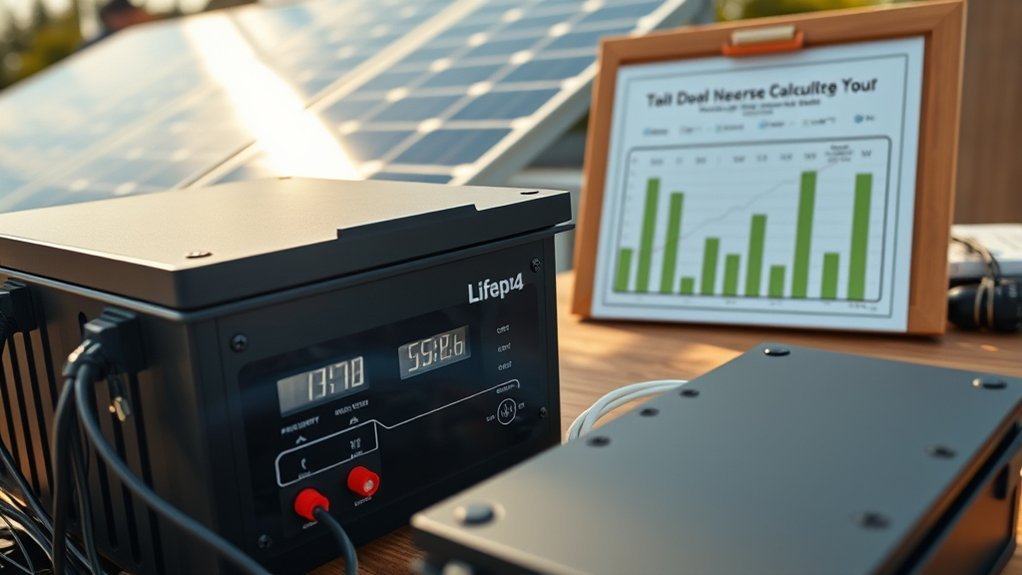
To determine your daily energy consumption, we start by measuring the power usage of each device in your system. Next, we estimate the total energy needs by multiplying each device’s wattage by its daily operating hours. This process provides a precise baseline for sizing your LiFePO4 battery system effectively.
Determine Power Usage
Determining your daily energy consumption is a critical step in selecting the appropriate off-grid LiFePO4 battery size. To do this accurately, we analyze your power usage, considering the specific battery chemistry and charging methods. A clear understanding of your device power draw ensures proper capacity planning. For visualization, consider this table:
| Device | Power Usage (W) | Daily Run Time (hours) |
|---|---|---|
| LED Lighting | 10 | 4 |
| Refrigerator | 100 | 2 |
| Solar Pump | 50 | 3 |
| Communication Gear | 20 | 1 |
Estimate Daily Needs
Estimating your daily energy needs involves calculating the total watt-hours consumed by all connected devices over a 24-hour period. To do this accurately, consider each device’s power draw in watts and multiply by its daily usage hours. Battery chemistry influences how efficiently energy is stored and discharged; Lifepo4 batteries, for example, offer high charging efficiency, typically around 95%, which minimizes energy loss during charging cycles. When estimating, factor in this efficiency to determine your actual energy requirements. Precise calculations guarantee your battery bank can handle daily loads without under- or over-sizing, optimizing longevity and performance. Understanding your total daily consumption allows for accurate sizing of your battery system, ensuring reliable off-grid power while maximizing lifespan and minimizing unnecessary expenses.
Understanding Battery Capacity and Its Impact on Performance
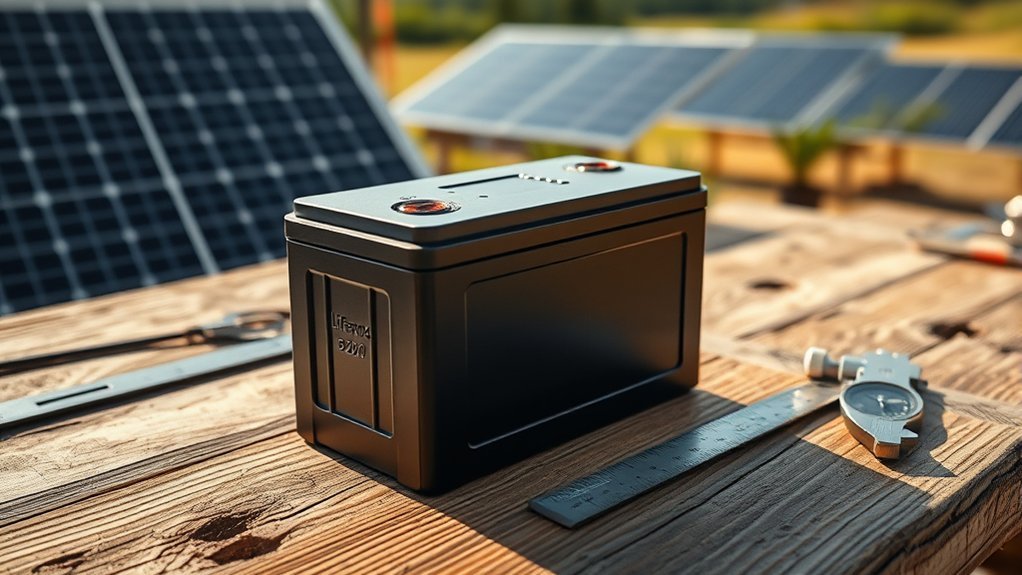
Understanding battery capacity is essential because it directly influences how long your off-grid system can operate without recharging. Battery capacity, measured in amp-hours (Ah), reflects the total energy storage, which depends on battery chemistry. Lithium Iron Phosphate (LiFePO4) batteries offer higher energy density and longer lifespan due to their stable chemistry, enabling more charging cycles before capacity degradation. The number of charging cycles directly impacts long-term performance, meaning a higher cycle count extends usable capacity over time. Accurate capacity assessment guarantees the system can meet energy demands reliably. Proper understanding of these factors allows for ideal sizing, ensuring your off-grid setup maintains consistent power without premature battery replacement or capacity shortfalls.
Determining the Optimal Battery Bank Size for Your Off-Grid Setup
To determine the most suitable battery bank size, we start by calculating your daily power consumption based on your load profile. We then evaluate available battery capacity options to meet these needs efficiently, ensuring sufficient reserve for variability. Finally, we consider system expansion potential to maintain scalability and reliability over time.
Calculating Daily Power Needs
Before selecting the appropriate battery bank size, we must accurately determine our daily energy consumption. This involves listing all electrical loads and their usage durations, then summing their watt-hours. Understanding battery chemistry, such as Lifepo4, is vital because it influences discharge characteristics and efficiency. Accurate calculations require factoring in inverter and charger efficiencies, especially when considering different charging methods, like MPPT or PWM chargers. We should also account for system losses and reserve capacity to guarantee reliability during low-generation periods. Precise daily power needs calculations prevent overestimating battery capacity, which can lead to unnecessary costs, or underestimating, risking system failure. This step is fundamental for designing a safe, efficient off-grid battery bank tailored to actual energy demands.
Considering Battery Capacity Options
How do we determine the ideal battery capacity for our off-grid system without overspending or risking insufficient power? First, we assess daily energy requirements, then consider safety margins to account for system inefficiencies. Selecting the right capacity involves balancing battery safety and environmental impact—overcapacity increases environmental footprint, while undercapacity risks system failure. To guide this, here’s a comparative overview:
| Capacity Range | Suitability |
|---|---|
| Small (10-20 kWh) | Limited for high consumption, eco-focused. |
| Medium (20-40 kWh) | Suitable for moderate power needs. |
| Large (40+ kWh) | Supports high demand, with added safety margins. |
This approach ensures optimal sizing, minimizes environmental impact, and maintains battery safety.
Balancing System Expansion
Balancing system expansion requires a careful assessment of current energy demands alongside future growth projections to determine the most suitable battery bank size. When evaluating expansion, it’s essential to take into account battery chemistry, as Lifepo4 batteries offer superior cycle life and stability, supporting more charging cycles over time. Proper sizing ensures that the bank can accommodate increased load without compromising longevity or performance. Overloading the system risks rapid degradation, while undersizing may lead to insufficient capacity. Precise calculations of energy requirements, factoring in future expansion, help identify an ideal battery size that maximizes lifespan and efficiency. Additionally, understanding the specific charging cycle characteristics of Lifepo4 chemistry allows for tailored charge management, ensuring balanced system expansion and sustained off-grid reliability.
How to Select the Right Battery Voltage and Series Configuration
Selecting the appropriate battery voltage and series configuration is essential to guarantee your off-grid system meets your power requirements efficiently. To do this, we must consider the battery chemistry, as LiFePO4 cells require specific voltage parameters for optimal performance and safety. Ensuring voltage compatibility across the entire system prevents issues like overvoltage or undervoltage, which can damage batteries or reduce lifespan. When configuring series connections, total voltage is the sum of individual cell voltages, so selecting the correct number of cells is critical to match your inverter and charge controller specifications. Properly balancing voltage and series arrangement ensures consistent performance, maximizes capacity, and maintains system reliability, making it indispensable to plan your battery configuration carefully for an effective off-grid power solution.
Considering Future Expansion When Picking Your Battery Size
When choosing the size of a LiFePO4 battery bank, it’s important to take into account potential future expansion to avoid costly upgrades or system redesigns later on. Considering battery chemistry, LiFePO4 offers high cycle life and stability, making it suitable for scaling up. Planning for additional capacity ensures compatibility with existing charging methods, such as MPPT or PWM controllers, which must handle increased current loads efficiently. It is crucial to select a bank size that accommodates future energy needs without compromising system performance or safety. Properly sizing now allows for seamless integration of larger capacity modules later, minimizing system downtime and technical adjustments. This foresight ensures your off-grid setup remains flexible, reliable, and capable of evolving with your energy demands.
Balancing Cost and Longevity: Finding Your Budget-Friendly Solution
Achieving an ideal balance between cost and longevity requires careful consideration of the initial investment against long-term performance. Conducting a thorough cost analysis helps identify upfront expenses versus ongoing maintenance and replacement costs. Longevity factors, such as cycle life and thermal stability, influence the total lifespan of the LiFePO4 battery, impacting overall value. While lower-cost options may seem attractive initially, they often compromise longevity, leading to higher replacement costs over time. Conversely, investing in higher-quality cells with superior longevity factors can reduce lifecycle expenses, delivering better long-term performance. Balancing these elements involves evaluating the trade-offs between upfront affordability and sustained durability, ensuring your off-grid system remains reliable without exceeding budget constraints.
Common Mistakes to Avoid When Choosing an Off-Grid LiFePO4 Battery
Choosing the wrong off-grid LiFePO4 battery can drastically undermine your system’s reliability and cost-efficiency. Common mistakes include neglecting proper assessment of battery chemistry, which impacts performance and safety. Selecting a battery with inadequate capacity leads to system strain and reduced lifespan. Failing to adhere to safety precautions during installation risks thermal runaway or damage.
To avoid these issues:
- Confirm the battery chemistry aligns with your power needs and safety standards.
- Accurately calculate your energy consumption to choose an appropriately sized battery.
- Follow strict safety precautions during installation and maintenance to prevent hazards.
Tips for Maintaining and Extending the Life of Your Battery Bank
Proper maintenance is essential to maximize the lifespan and performance of your battery bank. Confirm correct battery installation and adhering to safety precautions prevents damage and prolongs efficiency. Regularly monitor voltage and temperature to detect early signs of degradation. Avoid deep discharges; keep the state of charge within recommended levels. Use a compatible battery management system (BMS) for ideal cell balancing.
| Maintenance Task | Specific Action |
|---|---|
| Battery Installation | Verify secure connections and proper orientation |
| Safety Precautions | Wear protective gear during inspection |
| Voltage & Temperature | Use multimeters and thermal sensors |
| State of Charge | Maintain between 20-80% capacity |
| Regular Inspection | Check for corrosion or physical damage |
Adhering to these tips ensures longevity and safe operation.
Frequently Asked Questions
How Do Temperature Variations Affect Lifepo4 Battery Performance?
Temperature variations impact Lifepo4 battery performance considerably; thermal management guarantees temperature stability, preventing capacity loss or damage. We monitor and control temperatures actively, maintaining ideal conditions for longevity, safety, and reliable energy output in diverse environmental conditions.
What Safety Considerations Are Important When Sizing Batteries?
We prioritize safety by considering battery chemistry stability and ensuring voltage compatibility, preventing overcharging or overheating risks. Proper sizing minimizes thermal hazards and maintains system integrity, essential for reliable, safe off-grid energy storage solutions.
Can I Mix Different Brands or Capacities in One Battery Bank?
Mixing different brands or capacities isn’t recommended, as battery compatibility and capacity matching are vital for safe, efficient operation. Discrepancies can cause imbalance, reduced lifespan, and potential safety hazards, so uniformity guarantees ideal performance and longevity of your battery bank.
How Do Depth of Discharge Limits Influence Battery Life?
Ironically, shallow depth of discharge extends battery life, despite tempting deeper use. For Lifepo4 chemistry, limiting discharge to around 80% preserves charging cycles and prolongs overall lifespan, ensuring reliable power for your off-grid needs.
What Are Signs Indicating My Battery Bank Is Undersized?
If your battery capacity struggles to meet demand, you’ll notice frequent deep discharges and reduced charging efficiency, indicating your bank is undersized. These signs suggest the need for increased capacity to optimize performance and longevity.
Conclusion
In sum, selecting the suitable LiFePO4 battery size is a strategic, systematic process that safeguards system stability and supports sustainable scalability. We must meticulously measure, match, and monitor to maximize longevity and minimize costs. By balancing basic principles with careful calculations, we craft a reliable, resilient off-grid power solution. Remember, prudent planning and precise parameterization pave the path to prolonging performance and powering progress, ensuring off-grid independence endures with efficiency and excellence.