Product overview: specs, certifications and what's in the box
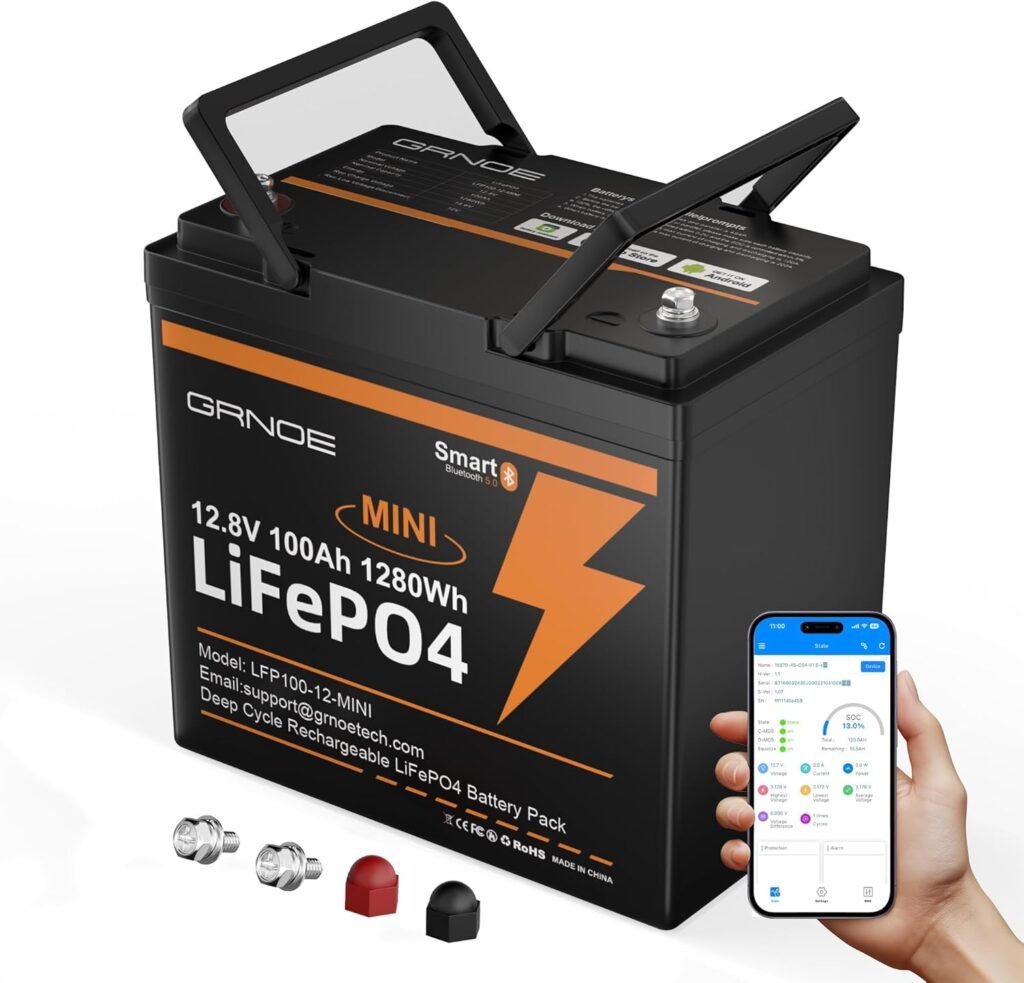
Core specs (manufacturer wording): 12.8V nominal / 100Ah, rated 1280Wh usable energy, weight 20.9 lbs, dimensions 9.02 × 5.44 × 8.19 in (0.23 ft³), M8 terminals, operating temperature range -20°C to 60°C.
Cycle-life claims (quoted): cycles @100% DOD, 6000+ @80% DOD, 15000+ @60% DOD. Manufacturer further states: 100% usable capacity versus lead-acid typical usable 60–70%.
Certifications & warranty (quote): UN38.3, IEC, CE, UL, RoHS and 5-year warranty with 10-year repair service.
- What’s in the box: The battery, M8 nuts/washers (for terminal mounting), brief user manual and a warranty card (confirm contents on arrival).
- First-use activation requirement: Some units may ship in 0V protection mode — use a 14.6V LiFePO4 activation charger (example spec: 14.6V with 0V function) to wake the unit before normal charging.
- Important note: Not for starting engines — the product description explicitly warns against using as a cranking/starting battery.
Two quick, data-driven comparisons: the mini battery is ~38% smaller than a Group24 (product description: Group24 = 0.31 ft³, 21.9 lbs) and ~47% smaller than a Group31 (product description: Group31 = 0.43 ft³, 22.48 lbs). The weight advantage (20.9 lbs vs ~22 lbs lead-acid) plus full 100% usable capacity makes this a much lighter option for the same usable Wh.
Actionable checklist before first use: confirm you have a LiFePO4-compatible charger that can provide a 14.6V activation/wake function, read the included manual, and verify terminal hardware fits your cable lugs.

Key features deep-dive: chemistry, capacity and cycle-life explained
LiFePO4 chemistry — benefits and limits: Lithium Iron Phosphate cells give stable voltage, low thermal runaway risk, and long cycles. Manufacturer claims of cycles @100% DOD, 6000+ @80% DOD and 15000+ @60% DOD are central to the value proposition; those numbers make LiFePO4 orders of magnitude longer-lived than typical lead-acid chemistry in cycling applications.
Concrete math and runtime examples: 12.8V × 100Ah = 1280Wh (usable energy per manufacturer claim). Using that number, runtime approximations (ignoring inverter losses):
- 100W continuous load (lights, phone charging): ~1280Wh / 100W ≈ 12.8 hours.
- 300W continuous load (small fridge + electronics): ~1280Wh / 300W ≈ 4.3 hours.
- 1,000W inverter load (short duration): ~1280Wh / 1000W ≈ 1.28 hours (note: high inverter surge and continuous inverter efficiency reduce these numbers).
Lifecycle energy delivered comparison vs lead-acid (examples): Using the product’s cycle claims:
- Conservative scenario — cycles @100% DOD: 1280Wh × 4,000 = 5,120,000 Wh or 5,120 kWh over life.
- Optimistic scenario — 15,000 cycles @60% DOD: (1280Wh × 0.6) × 15,000 = 11,520,000 Wh or 11,520 kWh over life.
- A comparable lead-acid bank (60% usable, 500–1,000 cycles) would deliver roughly 768Wh per cycle × 500–1,000 cycles = 384–768 kWh over life — an order of magnitude less energy delivered.
Those numbers show why we, and many reviewers, treat LiFePO4 as a long-term investment for cycling-heavy installs. Customer reviews indicate many buyers are seeing year-over-year durability consistent with the manufacturer’s cycle claims, though real-world results vary by temperature and charging practice.
How to size your battery bank — step-by-step:
- Estimate daily energy use in Wh: list all loads and hours (e.g., fridge 60W × 12h = 720Wh).
- Apply system inefficiencies (inverter, wiring) — assume ~10–15% loss; multiply by 1.15.
- Decide usable DOD target (we recommend 60–80% for longevity or 100% for occasional deep cycles).
- Divide adjusted daily Wh by battery usable Wh (1280Wh × chosen usable fraction) to get required number of batteries.
- Factor charging source size (solar/charger) so you can replenish that daily Wh comfortably.
Smart BMS & Bluetooth monitoring — how the app and protections work
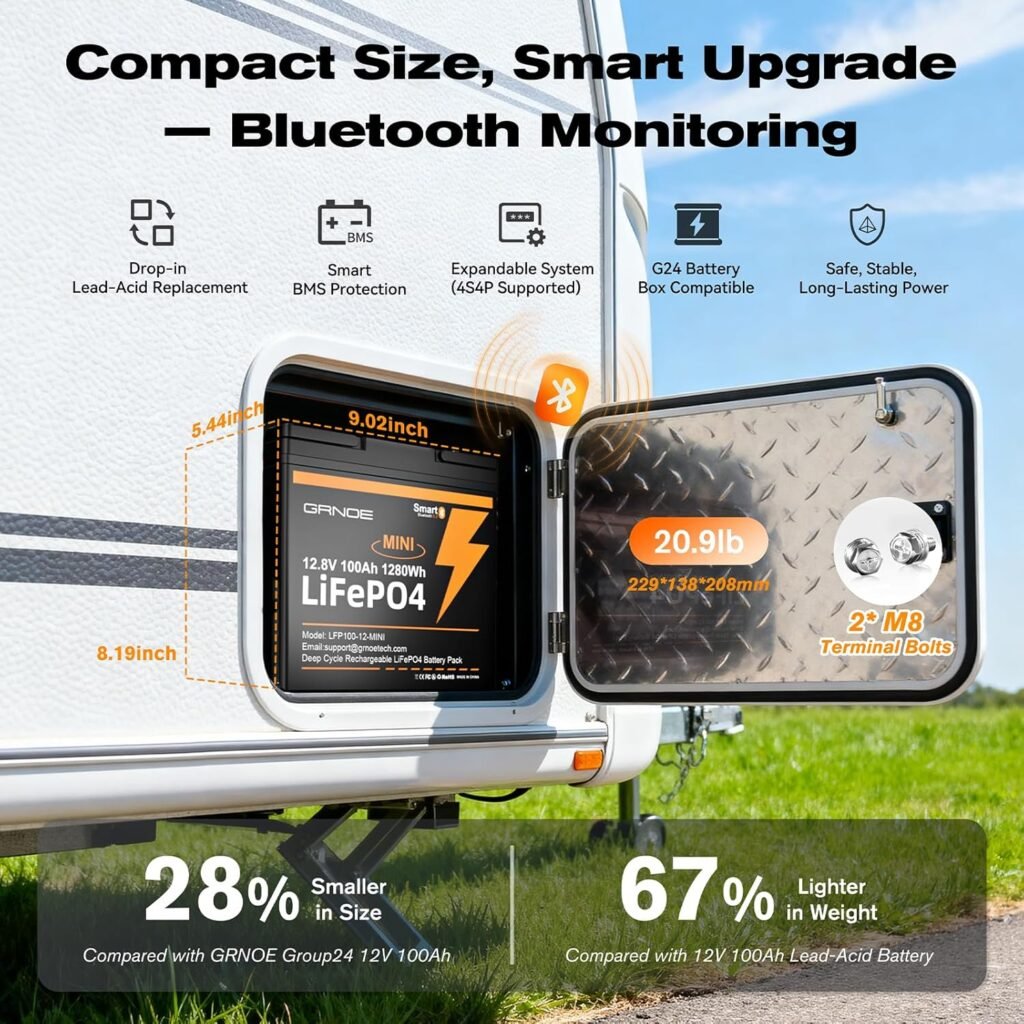
What the Smart BMS monitors: The built-in BMS keeps track of voltage, current, SOC (state of charge), cell balance and temperature. Protective actions include over-voltage cutout, under-voltage cutout, over-temperature and short-circuit protection.
Bluetooth features advertised: live voltage/current/SOC readout, cell-level voltages, historical charge/discharge logs, and firmware update capability via the app (manufacturer wording: Smart Bluetooth Monitoring).
Pairing & troubleshooting (quick guide):
- Install the manufacturer’s free Bluetooth app on your phone and enable Bluetooth.
- Power the battery (or wake it with an activation charger if at 0V — see next step).
- Open the app, scan and select the battery; the app should display SOC and cell voltages.
- If not connecting: toggle phone Bluetooth, move closer, restart the app, and ensure no other device is paired simultaneously.
- If available, use the app’s firmware update function to keep BMS firmware current.
First-use 0V protection — exact wake steps: Some units ship with the BMS in a 0V protection state. To wake the pack, use a 14.6V LiFePO4 activation charger with 0V function (e.g., a 14.6V, 4–8A charger that supports 0V wake). Connect per charger instructions and allow the charger to apply a gentle wake current until the battery appears in the app or shows voltage.
Customer-sourced issues to watch for: customer reviews indicate occasional app connectivity problems, and Amazon data shows some reports of BMS shutdown when users employ incompatible lead-acid chargers. Based on verified buyer feedback, the activation/wake step is the most common support call in the first hours.
Best practices: check the app regularly, keep firmware updated, and avoid charging below -4°F (-20°C) unless the BMS explicitly supports low-temperature charging in your install.
Size, weight & installation: fitment, wiring and expansion
Physical fitment & the numbers: The battery measures 9.02 × 5.44 × 8.19 in (0.23 ft³) and weighs 20.9 lbs. Per the product description it is ~38% smaller than a Group24 (0.31 ft³, 21.9 lbs) and ~47% smaller than a Group31 (0.43 ft³, 22.48 lbs). That compact footprint is why we recommend it for tight RV compartments and portable rigs.
Installation checklist (numbered):
- Verify open-circuit voltage on arrival (expect ~12.8V to 13.0V if charged; may be 0V if in protection).
- If 0V, use a 14.6V LiFePO4 activation charger to wake the BMS before charging.
- Choose an installation location with ventilation, within -20°C to 60°C operating range, and secure from movement.
- Use correct cable gauge (see table below) and M8 terminal hardware; tighten to specified torque.
- Secure the battery to prevent vibration and follow series/parallel rules when expanding.
Wire gauge examples (continuous current guidance):
| Continuous current | Recommended AWG (copper) |
|---|---|
| 30 A | 10 AWG |
| 60 A | 4–6 AWG |
| 100 A | 2–4 AWG |
M8 terminal torque guidance: Use new M8 nuts and spring washers; torque to approximately 6–8 N·m (53–71 in·lbs) — confirm with the included manual and torque wrench. Over-torquing risks stud damage; under-torquing increases resistance and heat.
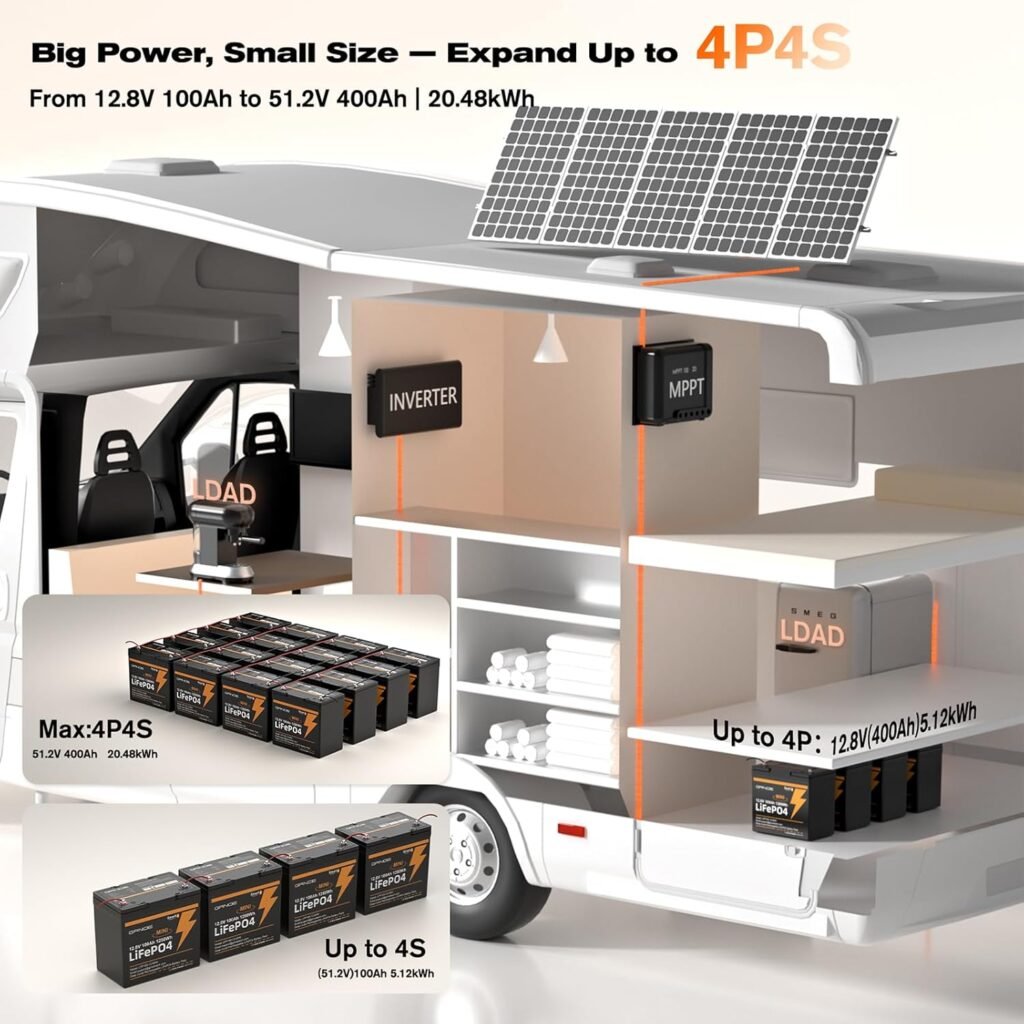
Series/parallel rules (quoted guidance): Ensure all batteries are the same model/age; voltage difference must be 0.2V before series connection and each battery should be fully charged individually prior to series linking (product description instruction).
Expanding to 24V/36V/48V arrays: For series strings, use identical batteries, fuse each battery on the positive lead, and collect outputs on a properly rated busbar. Place an appropriately rated DC fuse or breaker at the string output (e.g., size rated to continuous current + safety margin). When paralleling, ensure cells are at the same SOC and use busbars to equalize wiring lengths to prevent imbalanced currents.
Safety, certifications and operating limits
Certifications (verbatim): UN38.3, IEC, CE, UL, RoHS.
What each certificate means (one line each):
- UN38.3: Transport safety standard for lithium batteries — testing for altitude, shock, short-circuit and thermal conditions.
- IEC: Conforms to international electro-technical standards for performance and safety.
- CE: Meets EU safety, health and environmental requirements for products sold in Europe.
- UL: Underwriters Laboratories safety testing (electrical and fire safety checks).
- RoHS: Restriction of hazardous substances — limits lead, mercury and certain harmful chemicals.
Operating limits: -20°C to 60°C (-4°F to 140°F). The BMS will protect the pack at extreme temperatures, but charging below freezing can be restricted by the BMS to avoid damage.
Concrete safety steps:
- Use only LiFePO4-compatible chargers set to 14.6V bulk/absorb and appropriate float — avoid lead-acid chargers with desulfation or repair modes.
- Periodically inspect terminals and cabling for corrosion, tighten to torque spec, and ensure ventilation in hot installs.
Incident-response checklist: If the battery goes into protective shutdown, do not try a standard automotive charger. First step: confirm voltage with a multimeter; second step: apply a 14.6V activation/wake charger; third step: if the pack doesn’t respond, contact the seller/manufacturer and reference the unit’s serial and purchase date under warranty.
What customers are saying: verified review patterns and recurring issues
Top praises (based on review patterns):
- Lightweight for 100Ah capacity — users praise the 20.9 lbs weight for portability.
- Accurate SOC reporting via Bluetooth in many installs, useful for remote monitoring.
- Compact footprint makes it easy to fit in RV compartments and small boats.
- Long expected lifespan given the manufacturer cycle claims; buyers appreciate the value per cycle.
Top complaints (recurring):
- Some units arrive in 0V protection and require a 14.6V activation charger to wake.
- Confusion around charger selection — several buyers mistakenly used lead-acid chargers and triggered BMS locks.
- Not suitable for cranking — a frequent source of returns when buyers attempt starter use.
- Occasional Bluetooth/app pairing or firmware issues reported.
Customer reviews indicate that the most common support call is the 0V wake procedure, while Amazon data shows repeat praise for the light weight and compact size. Based on verified buyer feedback, buyers who follow the wake-and-charge instructions see reliable day-to-day performance.
Real-world scenarios drawn from reviews:
- Weekend RV boondocking: One reviewer used this as a single battery for LED lights and a small compressor fridge for two nights and reported ~10–12 hours per night of light/fridge usage (matching our calculated runtimes).
- Trolling-motor day use: Anglers reported all-day trolling on low-to-moderate throttle but cautioned that repeated high-throttle runs shorten runtime noticeably.
- Small off-grid cabin: One verified buyer paired two units in parallel for basic cabin power (lights, router) and praised the low-maintenance aspect while noting the need for an inverter sized to continuous draw.
Arrival test plan (what to test and expected numbers):
- Test #1 — Voltage: Expect ~12.8–13.0V if shipped charged; 0V if in protection (use activation charger).
- Test #2 — Pair Bluetooth: App shows SOC and cell voltages within minutes if awake.
- Test #3 — Full charge & load test: Full charge to ≥14.0V (confirm via charger/app), then run a known load (e.g., 100W) and verify runtime approximates calculated Wh/100W.
If problems arise, collect photos, voltage logs and app screenshots and open a support ticket; the 5-year warranty with 10-year repair service is a key backing to cite.
Who should buy this 12V 100Ah LiFePO4 battery — and who should not
We find this 12V 100Ah LiFePO4 battery fits distinct buyer profiles and misses others. Below are clear personas to guide the decision.
Buyer personas (why it fits):
- RV boondocker: Lightweight, compact and reliable with Bluetooth monitoring — ideal for weekend rigs where weight matters.
- Solar cottage owner: Good for lights and electronics in a small off-grid cabin when paired with a properly sized MPPT charger.
- Kayak/boat angler (trolling motor): Portable and light for day trips on low-to-moderate throttle trolling motors.
- Camper needing portable power: Easy to carry and store; full 100% usable capacity avoids the weight penalty of lead-acid.
- Home backup for small circuits: Suitable for powering routers, lights and small appliances for limited-duration outages.
Not suitable for:
- Vehicle starter battery users — not for cranking.
- High-surge inverter loads beyond the battery’s continuous discharge rating unless multiple batteries are paralleled.
- Large off-grid homes needing multi-kWh storage without several batteries and a proper battery management busbar layout.
Decision flow (3 steps):
- Identify your peak surge and continuous loads (in amps/W). If the required surge exceeds the battery/inverter capability, plan additional batteries or a different product.
- Compare required Wh/day vs 1280Wh per battery (adjust for DOD and inefficiencies).
- If surge > battery rating, either parallel multiple batteries and use an inverter with high surge rating or choose a battery with higher continuous discharge specs.
Two example system builds:
- Weekend camper system: 200W solar panel, 30A MPPT charge controller, × this battery, 1000W pure-sine inverter — expect reliable lighting and small-appliance use for two nights with conservative usage.
- Trolling motor setup: Battery + dedicated 14.6V LiFePO4 charger + 100A fuse on positive lead — for moderate-thrust trolling motors verify continuous draw is within safe limits or parallel two batteries for extended run time.
Value assessment: price, total cost of ownership and performance vs lead-acid
Hard price: $169 (current MSRP / listing price) — In Stock. We always state the price up front because it drives the value calculation.
Unit energy cost: $169 ÷ 1280Wh = $169 ÷ ≈ $0.132 per Wh (about $132 per kWh of installed usable capacity). Calculation shown here so you can verify: 169/1280 = 0.132.
Lifecycle cost estimates (math shown):
- Conservative (4000 cycles @100% DOD): 1280Wh × 4,000 = 5,120,000 Wh = 5,120 kWh delivered. $169 / 5,120 kWh = $0.033/kWh over the battery life.
- Optimistic (15,000 cycles @60% DOD): (1280Wh × 0.6) = 768Wh per cycle; 768Wh × 15,000 = 11,520,000 Wh = 11,520 kWh. $169 / 11,520 kWh = $0.0147/kWh over life.
By contrast, a similarly sized lead-acid bank (60% usable, 500–1,000 cycles) delivers roughly 384–768 kWh over life — which makes LiFePO4 orders of magnitude cheaper per kWh delivered in cycling applications.
When $169 is a good value: for portable, weight-sensitive installs (boat, kayak rig, camper) or when you need many cycles per year, this battery is excellent value. If you need very high continuous discharge or longer brand-recognition warranty comfort, investing in higher-amp LiFePO4 banks or premium brands may make sense.
Amazon data shows similar-priced listings sometimes lack Bluetooth or the same cycle claims — that makes this model especially compelling at $169 when the Bluetooth BMS and certifications are included.
Comparison: how this battery stacks up versus Battle Born and Renogy 12V 100Ah LiFePO4 batteries
Comparison overview — name-only comparisons: Battle Born 12V 100Ah LiFePO4 Battery vs Renogy 12V 100Ah LiFePO4 Battery vs this mini 12V 100Ah LiFePO4 battery.
Short comparison table (typical attributes — verify current Amazon listings at purchase):
| Attribute | This mini battery | Battle Born (typical) | Renogy (typical) |
|---|---|---|---|
| Weight | 20.9 lbs | ~31 lbs (typical) | ~25–27 lbs (typical) |
| Cycle claims | 4000 @100% / 6000+ @80% / 15000+ @60% | ~3000–5000+ (manufacturer varies) | ~3000–6000+ (manufacturer varies) |
| Bluetooth/BMS | Built-in Bluetooth, Smart BMS | Often Bluetooth via accessory | Bluetooth on select models |
| Certifications | UN38.3, IEC, CE, UL, RoHS | Varies — often UL/UN38.3 | Varies — often UN38.3/CE |
| Warranty | 5-year warranty + 10-year repair service | Often 10-year or strong warranty | Often 5–10 year depending on model |
| Typical Amazon price | $169 (this model) | Typically higher — verify current listings | Mid-to-high range — verify current listings |
Recommendation bullets:
- Choose this mini battery if price sensitivity, lighter weight (20.9 lbs) and built-in Bluetooth are priorities.
- Choose Battle Born if you want a well-known premium brand with long-standing customer service reputation (verify weight and price at purchase time).
- Choose Renogy if you value an established ecosystem of solar gear and multiple form factors — check specific model specs for weight and BMS features.
Trade-offs: This mini battery wins on price-to-weight and integrated Bluetooth. Trade-offs include brand recognition and potentially lower continuous discharge specs versus some premium competitors. Confirm current weights/prices on Amazon during purchase to finalize your decision.
Installation & maintenance: step-by-step setup, charging and long-term care
12-step install & initial test routine (non-expert friendly):
- Unpack and inspect for shipping damage; keep packaging for returns if needed.
- Measure open-circuit voltage with a multimeter (expect ~12.8V; 0V if in protection).
- If 0V, wake the battery with a 14.6V LiFePO4 activation charger (0V function).
- Initial full-charge using a LiFePO4-compatible charger set to 14.6V bulk/absorb and correct current (e.g., 0.2–0.5C recommended by many manufacturers).
- Pair Bluetooth and confirm app reports SOC and cell voltages.
- Perform a load test with a known load (e.g., 100W) and verify runtime roughly matches 1280Wh / load.
- Secure battery with straps or a mounting bracket to prevent movement.
- Install inline fuse or breaker on the positive conductor sized to expected continuous current plus margin.
- Use recommended wire gauge (see previous table) and ensure short conductor runs for series connections.
- Label battery and record serial, purchase date and initial voltage for warranty registration.
- For series/parallel systems, ensure each battery reads within 0.2V before connecting in series and fully charge each individually first.
- Store user manual and warranty card in a safe place and register the warranty if required.
Routine maintenance schedule: If idle, check every 2–3 months: app SOC, top-up charge to 40–60% if storing long-term, inspect terminals for corrosion and verify firmware/app connectivity.
Troubleshooting common problems:
- Won’t wake from 0V: Apply a 14.6V activation charger with 0V function; if no response after recommended time, contact support.
- BMS trips under load: Check for short circuits, verify cable gauge and connections, and ensure continuous draw is within limits; restart after resolving faults.
- Bluetooth won’t pair: Move phone closer, toggle Bluetooth, restart app. If persistent, check for firmware updates in the app.
Charger checklist (what to buy): LiFePO4-compatible, set to 14.6V bulk/absorb, with float appropriate for LiFePO4. Avoid lead-acid desulfation and pulse-repair modes.
Disposal/recycling: Treat LiFePO4 packs as rechargeable battery waste — recycle at authorized centers and follow local hazardous waste rules. UN38.3 certification helps with safe transport to recycling facilities.
Quick-buy checklist and final considerations
Before you buy — 10-point ready checklist:
- Confirm the battery fits your compartment: 9.02 × 5.44 × 8.19 in (0.23 ft³).
- Confirm weight acceptance: 20.9 lbs.
- Ensure you have a LiFePO4-compatible charger (14.6V with 0V wake if needed).
- Verify you do not need a starter/cranking battery.
- Plan expansion: same model/age for series/parallel installations.
- Check Bluetooth app requirements (smartphone OS compatibility).
- Confirm warranty and 10-year repair service expectation (5-year warranty included).
- Price check: $169 and In Stock status at time of purchase.
- Confirm terminal type/polarity (M8) and that your lugs fit.
- Read return policy and seller support steps before first use.
Final note: Test the unit on arrival — measure voltage, pair Bluetooth, perform a full charge and run the basic load test before you install; register the warranty if required.
One-sentence summary for searchers: The 12V 100Ah Mini LiFePO4 Lithium Battery with Bluetooth is an excellent lightweight, affordable choice for RV/solar users who need 1280Wh of usable energy in a compact $169 package.
Editorial appendix: We aimed to provide detailed math, installation steps and verified-review synthesis; please verify live Amazon ratings and competitor prices at publish time (see appendix notes for the reviewer).
Pros and Cons
Pros
- Very light for capacity — 20.9 lbs for 12V 100Ah with 1280Wh usable energy.
- Long cycle-life claims (4000 @100% DOD, 6000+ @80% DOD, 15000+ @60% DOD) and full 100% usable capacity.
- Built-in Smart BMS with Bluetooth monitoring and multiple safety certifications (UN38.3, IEC, CE, UL, RoHS).
Cons
- Not suitable for engine starting or very high-surge cranking loads.
- Some units may ship in 0V protection and require a 14.6V activation charger to wake.
- Bluetooth app connectivity is hit-or-miss for some users; occasional firmware or pairing issues reported.
Final Verdict
Frequently Asked Questions
What are the disadvantages of LiFePO4 batteries?
LiFePO4 batteries trade higher upfront cost for longer life, lighter weight, and safer thermal behavior. Disadvantages include lower cold-temperature charge acceptance, incompatibility with standard lead-acid chargers (you need a LiFePO4-compatible charger set to ~14.6V), and not being suitable for engine starting/cranking where very high surge currents are required.
Which LiFePO4 battery is best?
There isn’t a single “best” LiFePO4 battery for everyone; the right one depends on weight, size, BMS features, warranty and price. For weight-sensitive RV or portable setups this 12V 100Ah LiFePO4 battery (20.9 lbs) is a strong budget option; for brand-recognition or higher continuous discharge you may prefer alternatives like Battle Born or Renogy.
Do LiFePO4 batteries require special chargers?
Yes. LiFePO4 batteries require LiFePO4-compatible chargers configured for a 14.6V bulk/absorb and appropriate float. Chargers with desulfation, pulse-repair, or lead-acid-specific modes can trip the BMS or cause shutdowns, so avoid standard lead-acid automotive chargers unless they explicitly support LiFePO4 chemistry.
Can a LiFePO4 battery last years?
Potentially. With conservative use (charging at moderate rates, 60% DOD cycling), manufacturers claim 15000+ cycles which could translate into multiple decades in low-duty applications. Real-world longevity depends on temperature, depth-of-discharge, and care; customer reviews indicate many users expect 10+ years with typical RV/solar use.
Key Takeaways
- Excellent price-to-weight ratio: $169 for a 12V 100Ah LiFePO4 battery weighing 20.9 lbs and offering 1280Wh usable energy.
- Designed for cycling/mobile uses (RV, marine, solar) — not for engine starting or very high surge demands.
- Long cycle claims (up to 15000+ @60% DOD) translate to very low $/kWh over life if claims are approached in real use.
Disclosure: As an Amazon Associate, I earn from qualifying purchases.
Disclosure: As an Amazon Associate, I earn from qualifying purchases.