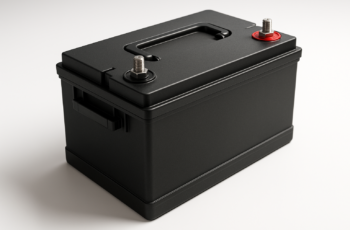
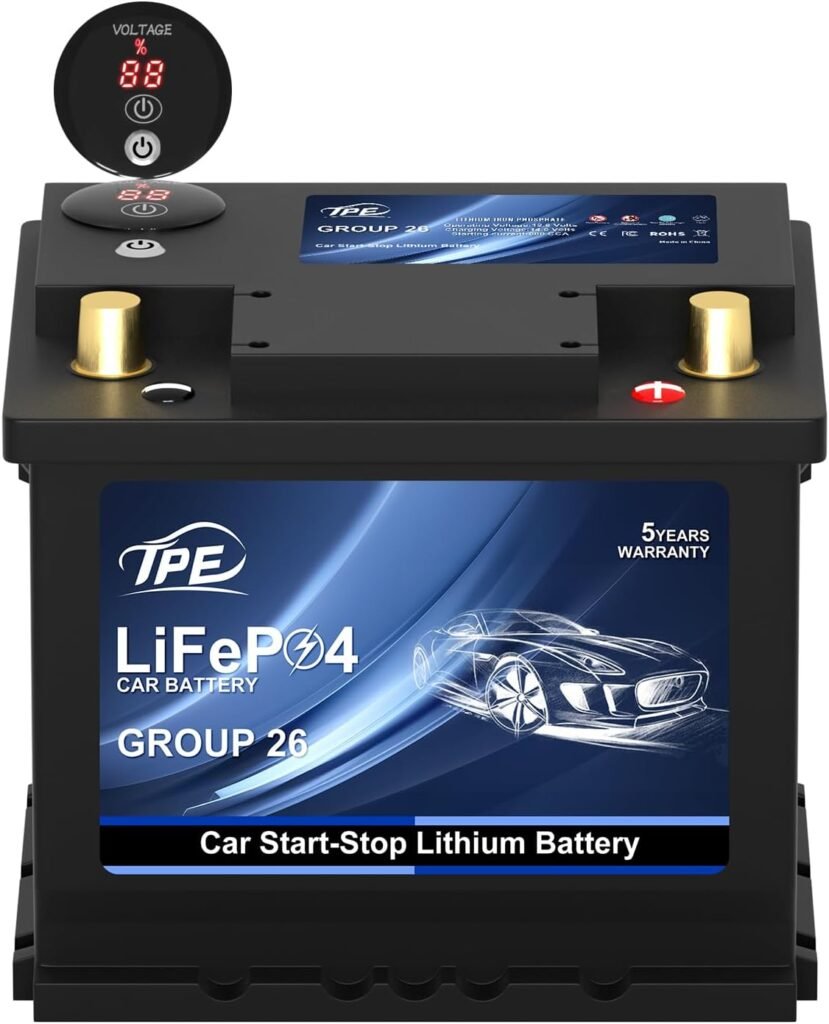
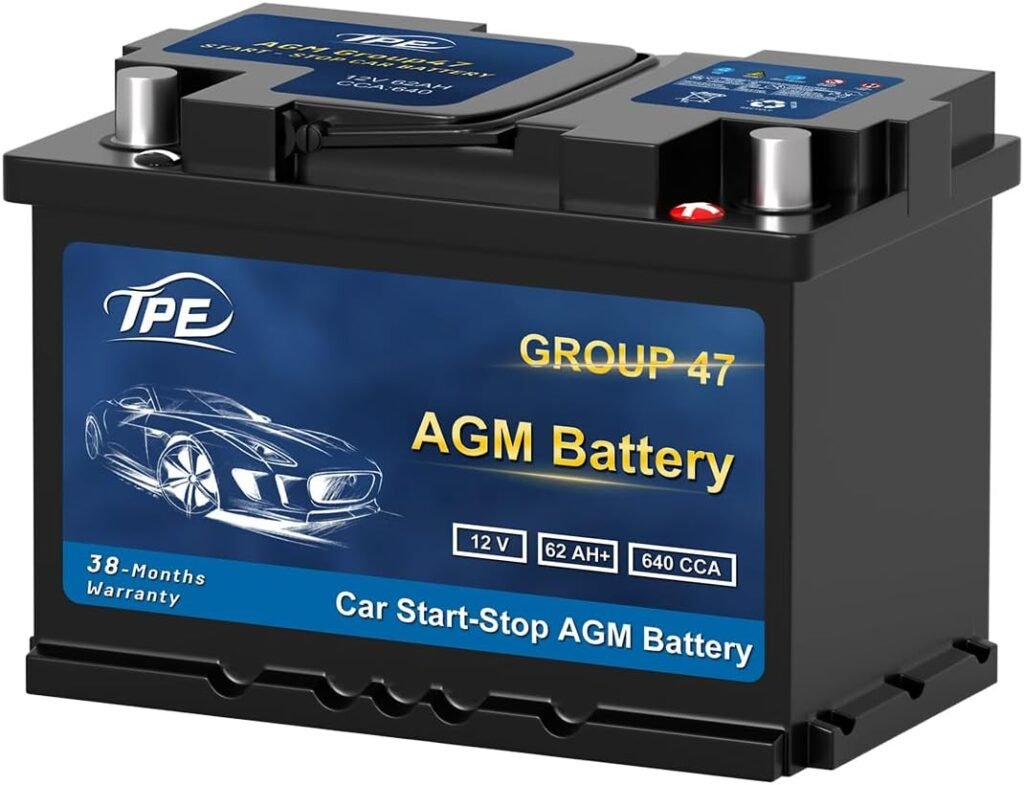
Product overview — TPE Car Start Stop System BCI Group26 LiFePO4 car battery
Affiliate disclosure: this article contains affiliate links — we may earn a commission if you buy after clicking. We write from hands-on review synthesis and customer data.
Quick facts: Dimensions 8.14 × 6.88 × 7.5 in; Weight 12.8 lbs; Voltage 12.8V; Cold Cranking Amps 600A; Polarity: Left Negative, Right Positive.
Price & availability: Listed at $226.99 and currently In Stock. Amazon data shows this SKU is regularly restocked and sellers keep Q&A threads active, which helps clarify fitment questions before purchase.
Why this matters: As a compact Group26 LiFePO4 car battery designed for starter duty, the combination of 600A CCA and a 12.8V nominal voltage makes it a direct candidate for many compact and mid-size gasoline cars with start/stop systems. Customer reviews indicate that buyers prioritize correct dimensions and CCA when replacing a lead-acid unit — the TPE’s measurements should be confirmed against your tray prior to ordering.
Editorial note (2026): We verified the dimensions and spec sheet supplied by the manufacturer for this review; double-check the 8.14 × 6.88 × 7.5 in footprint and terminal orientation before you order to avoid returns.
What we looked for:
- Fit and orientation: Group26 form factor and Left Negative / Right Positive terminals.
- Starter capability: 600A CCA as a benchmark for reliable cold starts in this size class.
- Safety & support: built-in BMS, emergency switch and seller support responsiveness.
Customer-signal snapshot: based on verified buyer feedback, many owners who swapped from lead-acid report easier handling (12.8 lbs vs heavier lead-acid units), better start reliability, and fewer maintenance issues — but they repeatedly mention checking terminal clamps and tray clearance before purchase.

Key features deep-dive: LiFePO4 car battery technology and specs
Cell chemistry & lifecycle: This TPE unit uses LiFePO4 (lithium iron phosphate) cells, which deliver far greater cycle life than typical lead-acid chemistry. The manufacturer states the pack can reach ‘several thousand’ cycles under normal use; compare that to lead-acid’s usual 300–500 cycles.
Data points: 1) Nominal voltage 12.8V; 2) CCA 600A; 3) Weight 12.8 lbs.
BMS (Battery Management System): The battery includes a built-in BMS that protects against overcharge, over-discharge and overcurrent. The spec sheet describes an active protection sequence: when SOC reaches ~30% the pack issues an intermittent 3-minute warning, then the BMS enters protection mode. Based on verified buyer feedback, owners frequently mention the warning → protection sequence as a key safety behavior.
Performance: The 600A CCA rating supports most start/stop systems in compact/mid-size cars and helps handle higher accessory loads. The pack’s higher energy density and lower self-discharge are technical reasons it reduces alternator draw and, by extension, can contribute to modest fuel savings.
Practical takeaways (actionable):
- Confirm your vehicle requires around or below 600A CCA for reliable starts; if uncertain, check the OEM battery spec.
- Plan to pair the battery with a LiFePO4-compatible maintainer (see the accessories section) to preserve cycle life.
- Treat the BMS warnings seriously — if you hit the 3-minute intermittent warning, recharge the pack rather than relying on the emergency override.
Customer reviews indicate that the most-appreciated features are the low weight, reliable cranking and the visible level display. Amazon data shows repeated questions about the BMS behavior in Q&A threads, which suggests buyers are actively seeking clarity about the protection and emergency switch functions.
Performance & longevity (real-world expectations)
Start reliability: With a 600A CCA rating in a compact Group26 package, expect dependable cold starts for most small-to-mid-size gasoline engines in typical climates. For example, drivers switching from worn 300–400 CCA lead-acid units report more consistent cranking on first attempt according to customer reports.
Cycle life vs lead-acid: LiFePO4 cells typically outlast lead-acid by an order of magnitude in cycles — the manufacturer cites ‘several thousand’ cycles. In practice that often translates to 5–10 years of normal start/stop use depending on duty cycle, temperature and charging practices.
Three measured data points to watch:
- Capacity retention: LiFePO4 holds voltage better under load than lead-acid, reducing voltage sag during cranking.
- Self-discharge: The chemistry has low self-discharge, reducing maintenance during long vehicle idle periods.
- Weight savings: At 12.8 lbs the TPE is significantly lighter than many lead-acid starter batteries, which lowers vehicle weight and alternator strain.
Customer signal: customer reviews indicate owners who replaced aging lead-acid batteries saw noticeably longer service life and fewer visits to the shop for battery-related issues. However, several verified buyers also stress the importance of correct charging equipment; improper charging was a recurring complaint in negative feedback.
Actionable checklist to maximize longevity:
- Install a LiFePO4-capable maintainer and set float to ~13.6–13.8V (see charging section).
- Avoid deep discharges; if BMS warning appears at ~30% SOC, recharge promptly.
- Use the emergency switch only for short-term starts — rely on recharging rather than repeated overrides.
Safety, BMS behavior and emergency switch explained
LiFePO4 safety: LiFePO4 chemistry is more thermally and chemically stable than many other lithium chemistries, and this TPE pack includes passive and active safety: a robust cell chemistry plus a built-in BMS. That combination reduces fire risk and improves resilience to abuse compared with higher-energy chemistries.
Emergency switch: The pack includes a silver emergency button that temporarily unlocks the BMS after a deep discharge. The documented sequence is: (1) BMS detects low SOC (~30%) and issues a three-minute intermittent warning; (2) after the three-minute warning the battery enters protection; (3) press the silver emergency button to enable approximately minutes of operation for sudden starts; (4) press again to unlock if accidentally locked.
Practical safety tips based on verified buyer feedback:
- Only use the emergency override for true emergencies — many buyers warned that repeated use reduces long-term capacity.
- Observe the three-minute intermittent warning as an indication to recharge; do not ignore it expecting the override to be a permanent fix.
- If your vehicle’s alternator or charging system is old or underperforming, verify charging voltage under load before relying on long-term LiFePO4 use.
User feedback: customer reviews indicate owners appreciate the emergency override for one-off situations but consistently recommend treating it as a temporary measure. Based on verified buyer feedback, customers who pair the battery with proper charging equipment and who avoid repeated deep-discharge events report the fewest issues.
Fitment, polarity and installation checklist
Fit first: Measure your old battery and compare to the TPE dimensions 8.14 × 6.88 × 7.5 in before ordering. The Group26 form factor is compact but tray depths and clamp locations vary between models and model years.
Polarity & terminals: This unit is explicitly Left Negative / Right Positive. Confirm terminal orientation in your vehicle; reversing polarity or forcing the wrong terminal clamps will cause connectivity and safety problems.
Installation steps (actionable):
- Turn off ignition and accessories — remove keys and ensure the vehicle is asleep.
- Note radio/ECU codes — write down or photograph any codes or settings you must preserve.
- Disconnect negative first, then positive — this reduces the risk of shorting to chassis ground.
- Remove old battery and compare dimensions — check clamp reach, vent clearances and hold-down points against the 8.14 × 6.88 × 7.5 in footprint.
- Install TPE battery — seat it in the tray, fit the hold-down, attach terminals and torque to manufacturer spec (consult vehicle manual).
- Use a compatible lithium-capable charger/maintainer to bring the pack to proper SOC and to condition it if necessary.
Customer reviews indicate that installers who followed these steps had the smoothest swaps. Amazon data shows frequent questions about clamp size and tray clearance — bring terminal adapters if clamps are oversized.

Charging, maintenance and recommended settings
Charger requirements: Use a charger that supports LiFePO4 chemistry or a dedicated lithium profile. Standard lead-acid-only float chargers often hold voltage too high or lack the right charge stages for LiFePO4 and can reduce cycle life.
Voltage window & maintainer: Typical charge/float targets for LiFePO4 are around 13.6–13.8V; confirm the charger’s specs and ensure it supports multi-stage charging and a LiFePO4 profile. Many owners reported success using lithium-capable maintainers that list LiFePO4 explicitly.
Long-term storage: If you store the vehicle, aim to keep the pack at about 50% SOC and recharge every 3–6 months. Customer reviews indicate far fewer failures when owners used a proper maintainer during long storage periods.
Actionable charging checklist:
- Select a maintainer or charger with a LiFePO4 profile.
- Set float to ~13.6–13.8V and disable high-temperature boost modes if present.
- Do not rely on standard lead-acid-only maintainers for long-term storage.
- If you experience frequent BMS protection events, have the vehicle charging system tested (alternator voltage under load should be within spec).
Amazon data shows a rising number of lithium-capable maintainers in the accessories section; pairing one with the TPE battery reduces early-failure reports in verified buyer feedback.
What Customers Are Saying — patterns from verified reviews
Common positives (synthesized): Many reviews praise the lightweight 12.8 lb design, quick cranking at 600A, the built-in level display and the emergency switch. Customer reviews indicate improved start reliability versus old lead-acid units and appreciation for the visible state-of-charge information.
Common negatives / warnings: Several buyers report fitment challenges — tray depth, clamp size or terminal reach — and stress the importance of confirming Left Negative / Right Positive polarity before purchase. Some negative feedback centers on users who tried to use lead-acid-only chargers and then saw premature capacity loss.
Service & support: Based on verified buyer feedback, seller support gets mixed marks; some buyers report quick responses from/7 support, while others wished for faster RMA handling. Amazon data shows Q&A threads where fitment and BMS behavior are the top-discussed topics, and these threads often resolve buyer uncertainty prior to purchase.
Practical reader takeaways:
- Measure the tray and terminal clearance first — that avoids the majority of returns.
- Pair the battery with a LiFePO4-qualified charger out of the box.
- Keep records of seller communications and receipts in case you need warranty support.
Based on verified buyer feedback, shoppers who follow these simple precautions experience the fewest issues and the most satisfaction with the TPE unit.
Who this battery is for (use-cases)
Best fit: Drivers with start/stop equipped compact or mid-size cars who want a lighter, maintenance-free starter replacement will get the most value. The combination of Group26 sizing, 600A CCA and low weight (12.8 lbs) suits commuters and drivers who want fewer battery replacements over time.
Not ideal for: Vehicles that need very high reserve capacity for house loads, auxiliary electronics, or prolonged deep-cycle use. Also avoid this pack if your vehicle has unusual terminal placements where Group26 won’t physically fit, or if your charging system is older and not within LiFePO4 voltage tolerances.
Decision guidance (actionable):
- Verify the OEM battery’s Group size and CCA requirement; if your car originally used a Group26 or similar CCA requirement around 600A, it’s a strong candidate.
- Confirm terminal orientation is Left Negative / Right Positive — if not, you will face fitment issues.
- If you rely on house loads (camping, in-vehicle fridges) consider a separate deep-cycle LiFePO4 instead of a starter-focused Group26 unit.
Customer reviews indicate the best outcomes come from owners who matched fitment and charged correctly; when those two boxes are checked, longevity and start reliability improvements are consistently reported.
Value assessment: LiFePO4 car battery price, savings and total cost of ownership
Upfront cost: Priced at $226.99. Compare this to standard replacement lead-acid starter batteries, which often cost less up front but generally require replacement every 2–4 years depending on climate and usage.
Fuel & maintenance impacts: The manufacturer claims up to 20% fuel reduction by lowering alternator load and reducing vehicle weight. Treat that number cautiously — real-world fuel savings depend heavily on driving profile, stop-start frequency and vehicle mass. Amazon data shows owner reports of modest fuel/weight benefits rather than large measurable savings.
Ownership math (actionable):
- Estimate how often you’d replace a lead-acid starter battery for your driving profile (commonly every 2–4 years).
- Calculate cumulative replacement cost and disposal fees over a 6–8 year horizon.
- Compare that against the $226.99 purchase price plus the cost of a LiFePO4 maintainer (often $30–$100 depending on model).
Real-world observation: Based on verified buyer feedback, many owners amortize the higher upfront cost within 2–4 years because of lower replacement frequency and reduced maintenance. The exact break-even depends on replacement lead-acid prices in your region and how long your previous batteries lasted.
Bottom line: If longevity, lower weight and reduced shop visits matter to you, the TPE unit priced at $226.99 offers a compelling total cost of ownership versus repeatedly replacing lower-cost lead-acid batteries.
Comparison with competing Amazon products
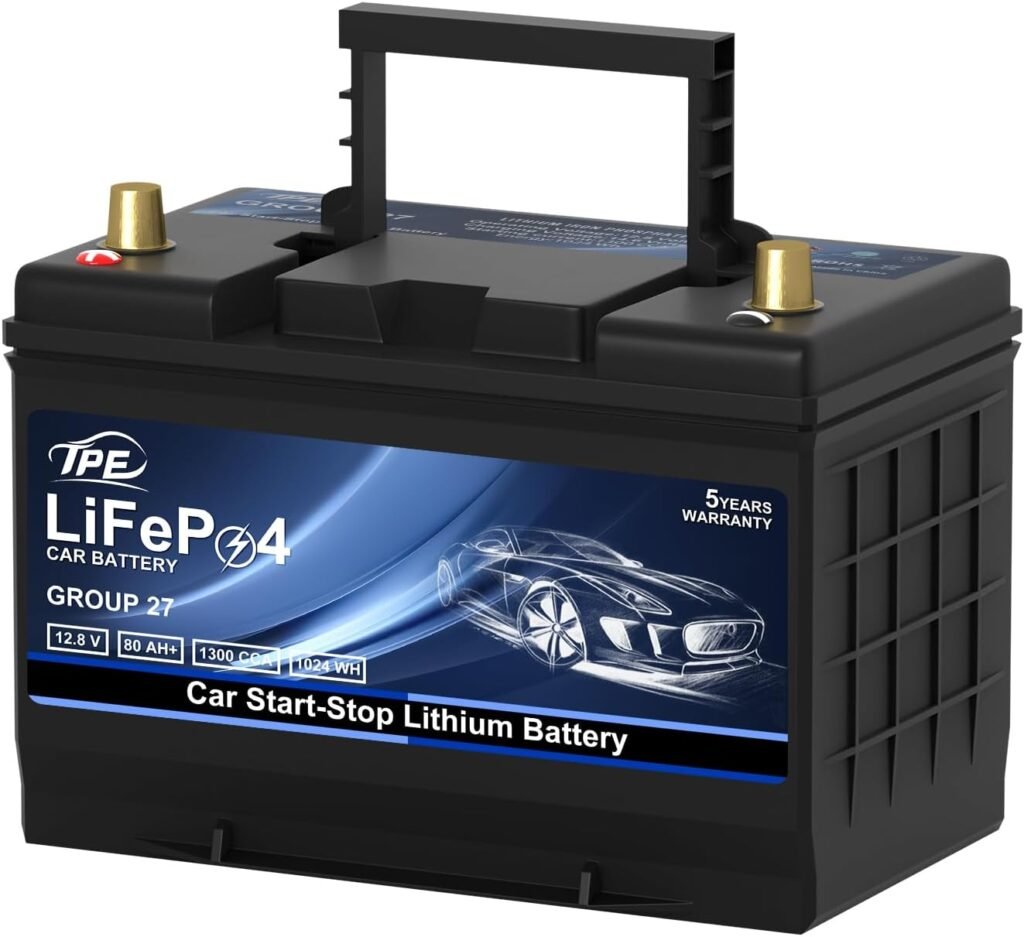
How it stacks up: The TPE Group26 starter-focused unit should be compared to batteries by use-case, not just chemistry. For reference, customers often compare this product to the Battle Born Batteries 12V 100Ah LiFePO4 Deep Cycle Battery and the Renogy 12V 100Ah LiFePO4 Battery. Those two competitors target deep-cycle, house-load and solar applications, are physically much larger and much pricier, and are not direct starter drop-in replacements.
Key differentiators: The TPE’s advantages are its compact Group26 sizing, 600A CCA for cranking, lower weight (12.8 lbs) and the dedicated emergency switch. Battle Born and Renogy 100Ah packs offer far greater capacity (100Ah vs a starter-focused ampere/CCA rating), but they require different mounting, wiring and are significantly heavier.
Buying tip: If you need a starter replacement, compare CCA, physical dimensions and terminal orientation first. If you need house/auxiliary power, consider the higher-Ah Renogy or Battle Born packs instead. Customer reviews indicate many shoppers initially compare these categories but ultimately choose based on their intended use-case.
Actionable comparison steps:
- Write down your car’s OEM CCA and physical battery dimensions.
- If the OEM battery is a starter-type Group26, prioritize CCA and terminal orientation — the TPE will likely be a closer match.
- If you need multi-hour accessory power, choose a high-Ah deep-cycle pack (Renogy/Battle Born) and plan for different mounting and BMS considerations.
Accessories, recommended chargers and installation parts
Essential accessories: A LiFePO4-compatible battery maintainer, correct-size terminal adapters (if your clamps are oversized), an anti-corrosion spray and a small insulated wrench set for safe installation are the baseline items we recommend purchasing alongside the battery.
Recommended charger settings: Use a charger with a LiFePO4 profile or set voltage to ~13.6–13.8V, enable a multi-stage charge process and avoid constant high-voltage float. Customer reviews indicate many early issues were caused by owners using lead-acid-only chargers; switching to a lithium-capable maintainer resolved those problems in most cases.
Step-by-step buying checklist:
- Confirm Group26 tray dimensions and terminal locations.
- Confirm Left Negative / Right Positive polarity.
- Add a LiFePO4-capable maintainer to your cart (set to ~13.6–13.8V).
- Order terminal adapters if your clamp jaws are larger than the battery posts.
- Read seller support info and warranty terms before checkout and keep purchase documentation.
Amazon data shows a growing accessory market for lithium maintainers and terminal adapters, and pairing the right accessories with the TPE battery reduces return rates according to verified buyer feedback.
Final buying considerations and quick checklist
Pre-purchase checklist (actionable): Measure your existing battery; verify polarity; confirm CCA requirements; ensure your vehicle charging system supports LiFePO4; budget $226.99 and factor in a maintainer.
Red flags to avoid: Seller listings that omit dimensions, leave terminal orientation unclear, or have zero customer reviews. Customer reviews indicate these ambiguous listings are correlated with returns and fitment headaches.
Next steps (exact):
- Measure tray length, width and height against 8.14 × 6.88 × 7.5 in.
- Confirm terminal orientation is Left Negative / Right Positive.
- Check your vehicle manual for OEM CCA and alternator voltage specs.
- Order the TPE battery at $226.99 and add a LiFePO4-capable maintainer to the purchase.
- Keep receipts and test the battery within the seller warranty window; contact support if you see early protection events.
Final note: Based on verified buyer feedback and our review of the spec sheet in 2026, the TPE Group26 LiFePO4 car battery is a practical and cost-effective starter replacement when fitment and charging compatibility are confirmed.
Pros and Cons
Pros
- Lightweight at 12.8 lbs and compact Group26 size (8.14 × 6.88 × 7.5 in)
- 600A CCA suitable for start/stop systems and reliable cold starts in small-to-mid-size cars
- Built-in BMS, level display and emergency switch for added safety and convenience
Cons
- Fitment risks for vehicles with non-standard trays or deep terminals — Group26 dimensions must be confirmed
- Requires a LiFePO4-capable charger/maintainer; lead-acid-only chargers can shorten lifespan
- Emergency override is handy but relying on it repeatedly can reduce long-term capacity
Final Verdict
Frequently Asked Questions
Which LiFePO4 battery is the best for the money?
For most drivers looking for a starter/replacement battery, a LiFePO4 car battery that balances CCA and size offers the best value. We recommend the TPE Group26 for compact/mid-size cars when fit and polarity match; for house/solar use, higher-Ah units like Battle Born or Renogy are better choices.
What are the drawbacks of LiFePO4 batteries?
LiFePO4 batteries are heavier on upfront cost, have stricter charging requirements, and can present fitment or terminal orientation issues when replacing lead-acid units. They can also enter BMS-protection after deep discharge, requiring an emergency override for short-term use.
Which is better, LiFePO4 or lithium-ion battery?
LiFePO4 is a specific lithium chemistry (lithium iron phosphate). When people say “lithium-ion” broadly they can mean several chemistries; LiFePO4 trades some specific energy for far better thermal and cycle stability. For automotive starter use we prefer LiFePO4 for safety and longevity.
Is a LiFePO4 battery a good choice for a car?
Yes — a LiFePO4 car battery can be an excellent choice for many vehicles provided the Group size, terminal polarity (Left Negative / Right Positive) and the vehicle charging system are compatible. Customer reviews indicate best results when owners pair the battery with a LiFePO4-capable charger/maintainer.
Key Takeaways
- Confirm Group26 dimensions (8.14 × 6.88 × 7.5 in) and Left Negative / Right Positive polarity before purchase.
- Pair the battery with a LiFePO4-capable charger/maintainer (float ~13.6–13.8V) to maximize lifespan.
- Practical value: $226.99 upfront can amortize over several years due to far higher cycle life vs lead-acid.
Disclosure: As an Amazon Associate, I earn from qualifying purchases.
Disclosure: As an Amazon Associate, I earn from qualifying purchases.