When planning a Lifepo4 battery system for home backup, precise sizing is critical to guarantee reliability and longevity. We recognize that balancing energy needs, peak loads, and future expansion presents complex challenges. By systematically analyzing household consumption patterns and technical specifications, we can develop an ideal configuration. This process demands careful attention to detail, and the consequences of miscalculations can be costly or inadequate. Exploring these factors thoroughly is essential to crafting an effective backup solution.
Key Takeaways
- Analyze your household’s daily energy consumption to determine the appropriate battery capacity for reliable backup.
- Match battery capacity closely to your calculated energy needs, considering DoD and efficiency to extend lifespan.
- Choose Lifepo4 chemistry for safety, deep discharge tolerance, and system longevity, ensuring compatibility with inverters and controllers.
- Consider future energy demands and system scalability by selecting modular batteries for easy capacity expansion.
- Regularly reassess and optimize your system based on consumption patterns and seasonal variations to ensure ongoing reliability.
How to Determine Your Home’s Energy Needs for Battery Sizing
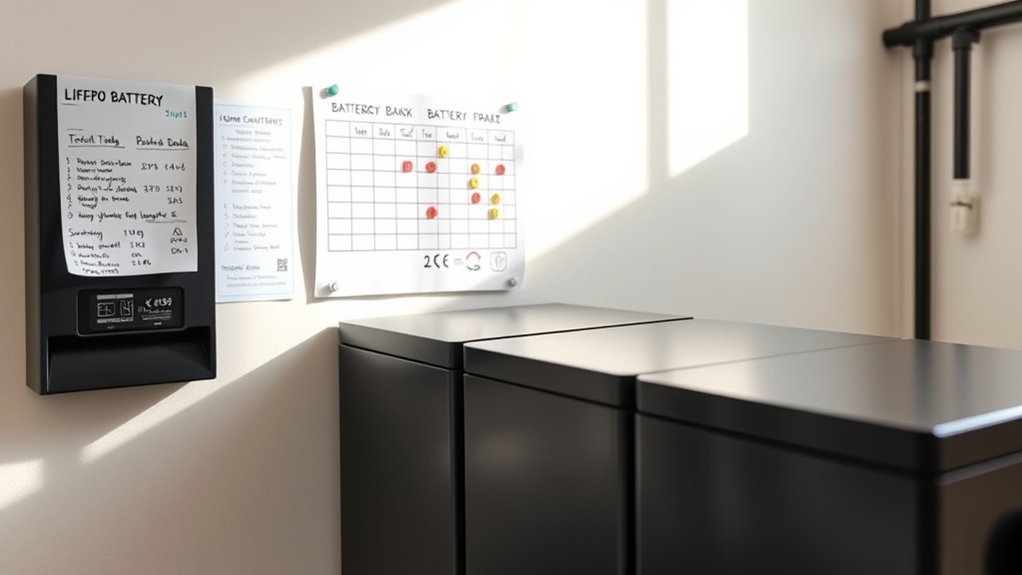
To accurately size a Lifepo4 battery for home backup, we must first determine the home’s total energy consumption. This involves analyzing the electrical load, including essential appliances and systems, over a specified period, typically a day. Understanding the battery chemistry is vital, as Lifepo4 offers high safety, stability, and efficiency, ideal for renewable integration. By calculating the average daily energy use in watt-hours, we establish the baseline capacity needed to sustain critical loads during outages. We also account for factors like depth of discharge and system efficiency, ensuring the battery can reliably meet demand. Precise measurement of energy needs enables ideal battery sizing, maximizing lifespan while supporting renewable sources and minimizing the risk of under- or over-sizing.
Key Factors to Consider When Choosing a Lifepo4 Battery Size
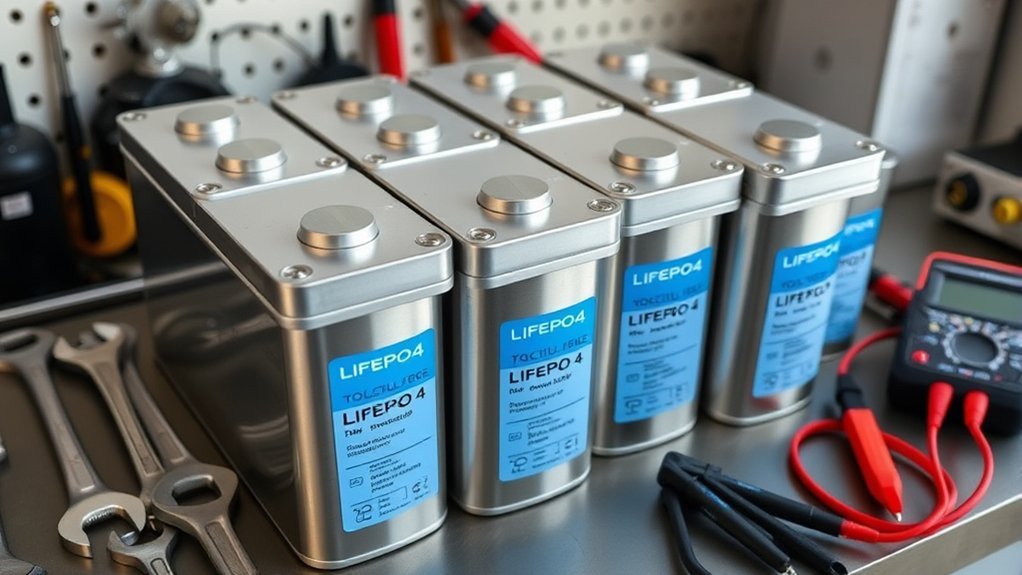
Selecting the appropriate Lifepo4 battery size requires careful consideration of multiple technical factors that directly impact system performance and longevity. Key among these are battery chemistry and charging protocols. Lifepo4 chemistry offers high thermal stability, long cycle life, and safety advantages, influencing ideal sizing. Understanding the specific charge and discharge characteristics associated with Lifepo4 ensures the battery can handle your household’s load demands without premature degradation. Proper charging protocols, including voltage limits and current rates, are essential to maximize lifespan and maintain capacity. Additionally, considering how these protocols align with your system’s inverter and charge controller specifications helps prevent overcharging or undercharging. By evaluating these factors thoroughly, we can select a battery size that balances capacity, safety, and longevity for reliable home backup.
Calculating Your Household Power Consumption and Peak Loads
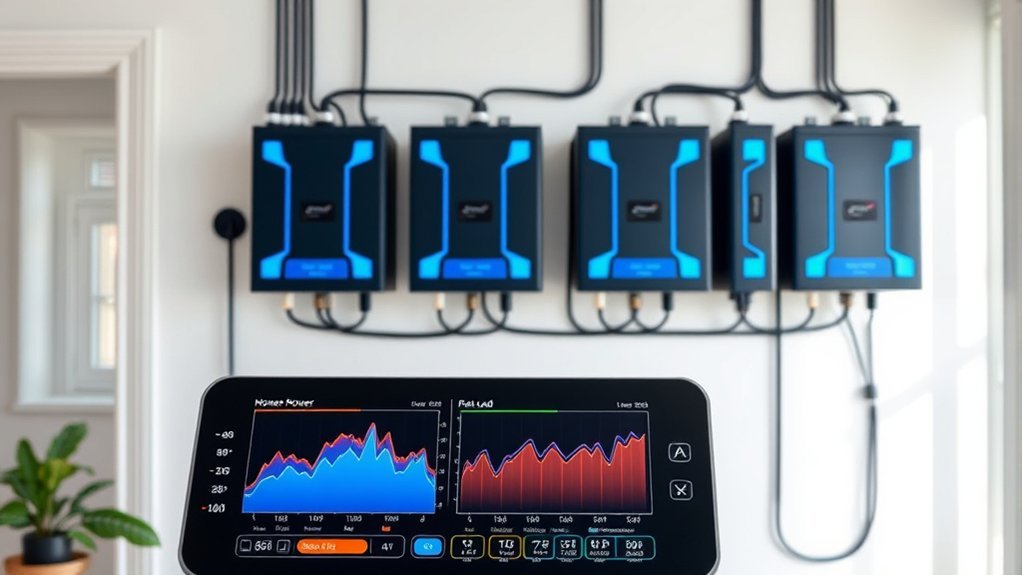
Understanding your household’s power consumption and peak load demands is essential for accurate battery sizing. To do this, we analyze electrical usage patterns, noting the wattage of appliances and their operational durations. This data helps determine the total energy requirement and the maximum power draw during peak periods. When calculating loads, consider the battery chemistry—such as LiFePO4—since it influences discharge rates and efficiency. Accurate load assessment supports effective renewable integration, ensuring your system can meet demand during periods of low generation. By quantifying both steady-state consumption and peak loads, you establish a reliable foundation for sizing your Lifepo4 battery bank, optimizing performance, lifespan, and backup reliability in your renewable energy setup.
Understanding Depth of Discharge and Its Impact on Battery Life
Understanding depth of discharge (DoD) is essential for enhancing battery lifespan, as it directly influences the number of charge cycles a Lifepo4 battery can endure. Higher DoD levels accelerate battery degradation, reducing overall longevity, while maintaining discharge within ideal limits extends service life. We will examine the recommended discharge thresholds to maximize performance and durability.
Depth of Discharge Explained
Depth of discharge (DoD) is a critical parameter that directly influences the lifespan and performance of LiFePO4 batteries. It measures the percentage of the battery’s capacity utilized during discharge, affecting the total number of charging cycles the battery can endure. Understanding the relationship between battery chemistry and DoD is essential, as LiFePO4 cells tolerate higher DoD levels more effectively than other chemistries, enabling deeper discharges without markedly compromising longevity. Each charging cycle reduces capacity over time, but maintaining a lower DoD prolongs the overall cycle life. By managing DoD appropriately, we optimize battery longevity and maximize usable capacity, ensuring reliable power backup for your home. Properly balancing discharge levels is key to efficient, durable energy storage solutions.
Effects on Battery Longevity
Managing the depth of discharge (DoD) directly impacts the lifespan of LiFePO4 batteries, as each cycle of use contributes to capacity degradation over time. Due to the stable battery chemistry and high energy density of LiFePO4 cells, limiting DoD can effectively prolong their cycle life. Deeper discharges accelerate capacity fade, reducing overall longevity. Conversely, shallow cycles preserve battery health and maximize long-term performance.
- Lower DoD results in fewer charge cycles over the battery’s lifespan
- Preserves the battery’s energy density and capacity retention
- Minimizes thermal stress and reduces aging effects
- Extends the effective cycle life of LiFePO4 chemistry
- Ensures peak performance for home backup systems over time
Optimal Discharge Levels
How do we determine the most favorable discharge levels to maximize LiFePO4 battery lifespan? The answer hinges on understanding battery chemistry, which influences ideal depth of discharge (DoD). LiFePO4 chemistry tolerates deeper discharges better than other chemistries, often up to 80-90% without significant lifespan reduction. However, environmental factors like temperature also impact this relationship; high temperatures accelerate capacity fade, while cold conditions can reduce available capacity, prompting conservative discharge practices. To enhance lifespan, we balance maximizing usable capacity with minimizing stress on the battery, typically limiting DoD to around 80%. This approach ensures durability, maintains performance, and accounts for environmental influences, ultimately extending the service life of our LiFePO4 batteries in home backup systems.
How to Estimate Backup Duration for Critical Appliances
Estimating the backup duration for critical appliances is essential to designing an effective LiFePO4 battery system. The process involves calculating energy requirements based on appliance power consumption, considering the battery chemistry’s efficiency, and adhering to proper charging protocols. To accurately predict runtime, we analyze:
Calculating backup duration ensures reliable power for critical appliances during outages.
- Total watt-hour consumption of each appliance during outage periods
- Battery capacity in watt-hours, factoring in depth of discharge limits
- Efficiency losses due to battery chemistry and inverter conversion
- Charging protocols to guarantee ideal battery health and readiness
- Estimated recharge times to restore capacity between outages
Selecting the Right Battery Capacity Based on Your Home Setup
Selecting the appropriate battery capacity begins with analyzing your home’s energy profile and backup needs. We assess the total energy consumption of critical appliances and desired backup duration to determine capacity requirements. Battery chemistry influences capacity choices; for example, Lifepo4 batteries offer high energy density and long cycle life, making them suitable for sustained backup. The installation location plays a vital role, as it impacts ventilation, temperature control, and accessibility, which in turn affect battery performance and safety. Accurate capacity sizing guarantees reliable backup while avoiding unnecessary costs. By combining detailed load analysis with consideration of battery chemistry and best installation practices, we can select a capacity that provides seamless, efficient power support during outages tailored to your home’s specific setup.
Balancing Cost and Performance: Avoiding Over- or Under-Sizing Batteries
Balancing cost and performance is essential to guarantee your battery system is both economically viable and reliable. Over-sizing leads to unnecessary expenses and diminished return on investment, while under-sizing risks insufficient energy storage and system failure. To optimize performance, consider the specific battery chemistry, as Lifepo4 offers high energy density and longevity, which can reduce total costs over time. Properly sizing batteries ensures you meet your energy storage needs without excess capacity, minimizing upfront costs and maximizing lifespan.
Balancing cost and performance ensures reliable, cost-effective battery systems tailored to your energy needs.
- Match battery capacity closely to daily energy demand
- Prioritize high-quality battery chemistry for durability
- Avoid oversizing to reduce initial investment
- Consider system efficiency and energy loss factors
- Regularly reassess your energy storage requirements as use evolves
The Role of Inverter Size and Compatibility in Battery Sizing
The inverter serves as the critical link between your battery bank and the household electrical system, converting DC power into usable AC power. Its size and compatibility are essential for peak system performance, especially considering Lifepo4 battery chemistry’s high charge and discharge efficiency. An inverter must handle the maximum load, including startup surges of appliances, without being oversized, which can reduce efficiency. Compatibility also involves matching the inverter’s power rating with the battery’s continuous discharge current and accounting for the number of charging cycles Lifepo4 batteries can endure. Proper sizing ensures the inverter can efficiently utilize the battery’s capacity while preserving lifespan. Accurate compatibility considerations prevent system bottlenecks, optimize energy flow, and maximize the lifespan of both the inverter and battery bank.
Practical Tips for Scaling Your Battery System as Your Energy Needs Grow
To effectively scale your battery system, we must first accurately project future energy demands based on current usage trends. Selecting modular battery options enables incremental capacity expansion without significant system overhaul, while planning for seamless system integration guarantees reliable performance as your needs evolve. By implementing these strategies, you can optimize system flexibility and longevity.
Assess Future Energy Demands
As your energy consumption patterns evolve, it becomes essential to accurately assess future demands to guarantee your battery system can scale accordingly. Properly evaluating future energy needs involves analyzing potential increases in load, considering seasonal variations, and accounting for renewable integration. Understanding battery chemistry helps determine scalability, as some chemistries support deeper cycling and higher capacity expansion. Projecting long-term usage trends enables precise sizing to prevent under- or oversizing. Additionally, anticipate changes in appliances or lifestyle that could impact energy consumption. Regularly reviewing your consumption data ensures your system adapts effectively.
- Anticipate increased load from new appliances or technology
- Consider seasonal fluctuations and peak demands
- Evaluate renewable energy generation growth
- Analyze battery chemistry capabilities for expansion
- Plan for future integration of additional renewable sources
Choose Modular Battery Options
Selecting modular battery options allows us to efficiently scale our home backup system in line with evolving energy requirements. When choosing modules, we prioritize compatible battery chemistries, such as Lifepo4, known for safety and long cycle life. Modular systems enable incremental capacity additions, avoiding large upfront investments. It’s essential to *think about* charging methods; compatible modules should support consistent charging protocols to optimize lifespan and performance. Properly implemented, these modules facilitate seamless expansion without complicated reconfigurations. Ensuring uniform battery chemistry across modules prevents issues related to differing charge and discharge characteristics. Modular configurations also simplify maintenance and troubleshooting. By selecting flexible, compatible battery modules, we create a scalable, reliable energy backup system tailored to future growth, maximizing system efficiency and longevity.
Plan for System Expansion
How can we effectively plan for future system expansion to guarantee our battery backup remains reliable and cost-efficient? Proper planning involves selecting scalable Lifepo4 battery modules that accommodate increasing energy demands without significant overhauls. Consider future load growth and guarantee the system’s architecture supports modular addition. Integrate considerations for renewable integration to optimize energy flow and storage capacity. Additionally, prioritize battery recycling options to sustainably manage aging or replaced modules. Maintaining a flexible design minimizes costs and reduces downtime during expansion phases. Regularly assess load forecasts and system performance metrics to inform expansion timing. Emphasizing these strategies ensures seamless scalability while maintaining system integrity and environmental responsibility.
- Select modular battery systems compatible with expansion
- Plan for renewable energy integration at each stage
- Incorporate battery recycling protocols for sustainability
- Include future load assessments in initial sizing
- Design with scalability to minimize retrofit costs
Common Mistakes to Avoid When Sizing Lifepo4 Batteries for Home Backup
When sizing Lifepo4 batteries for home backup, it’s critical to avoid common pitfalls that can compromise system performance and longevity. A key mistake is overestimating capacity, which leads to unnecessary costs and waste, impacting battery recycling efforts and increasing environmental impact. Conversely, underestimating capacity can cause system failures during outages, risking damage to connected appliances. Ignoring depth of discharge (DoD) and charging cycles shortens battery lifespan and reduces overall efficiency. Properly matching your load requirements and considering future expansion is essential. Additionally, neglecting proper system sizing may result in increased waste at the end of battery life, affecting environmental impact. Precise sizing, based on accurate load calculations, ensures ideal performance, prolongs battery life, and minimizes disposal issues, supporting responsible battery recycling and environmental sustainability.
Frequently Asked Questions
How Does Climate Affect Lifepo4 Battery Performance?
Climate effects considerably impact Lifepo4 battery performance; extreme temperatures can reduce battery durability, causing capacity loss or safety concerns. We recommend monitoring temperature ranges and implementing thermal management to optimize lifespan and maintain efficient energy storage.
Can Lifepo4 Batteries Be Expanded Later?
Lifepo4 batteries offer excellent expansion potential through modular design, enabling battery scalability. We can add cells or modules later, making them suitable for evolving power needs without compromising performance or safety, ensuring flexible, scalable energy storage solutions.
What Safety Precautions Are Necessary With Large Battery Systems?
Like vigilant guardians, we must guarantee proper ventilation requirements to prevent battery fire risks. Always install large battery systems in well-ventilated spaces, use fire-resistant materials, and maintain regular inspections for safety and early hazard detection.
How Do Different Inverter Types Impact Battery Sizing?
Different inverter types influence battery sizing through inverter compatibility and battery efficiency; we select inverters compatible with our batteries to optimize efficiency, ensuring proper power handling and minimizing losses for reliable, scalable home backup energy systems.
Are There Specific Maintenance Requirements for Lifepo4 Batteries?
A stitch in time saves nine; Lifepo4 batteries need regular maintenance, including proper charging cycles and responsible battery recycling, to guarantee longevity. We recommend monitoring voltage levels and avoiding deep discharges for peak performance.
Conclusion
In the end, misjudging your battery needs is like bringing a spoon to a steak dinner—ineffective and frustrating. Proper sizing guarantees your Lifepo4 system handles peak loads without sacrificing longevity or performance. Think of it as engineering a fortress, not a paper house, so your backup power stands firm when it’s needed most. By avoiding over- or under-sizing, you’re fundamentally safeguarding your home’s energy future—because nobody wants a backup system that’s more show than go.