Understanding the thermal stability of LiFePO₄ batteries is essential for evaluating their safety in various applications. Their inherent chemical and structural properties markedly reduce the risk of thermal runaway, but this resilience isn’t solely due to chemistry. Factors like design, manufacturing standards, and operating conditions also play critical roles. Exploring these aspects can reveal how LiFePO₄ batteries manage heat and prevent catastrophic failures, prompting us to examine what makes them inherently safer than other lithium-ion chemistries.
Key Takeaways
- LiFePO₄ batteries have higher inherent chemical stability, reducing the risk of thermal runaway.
- Stable crystal structure and lower voltage operation enhance thermal resistance.
- Advanced safety features and manufacturing standards prevent internal shorts and overheating.
- Proper thermal management and controlled usage conditions extend battery lifespan and safety.
- Recycling and safety protocols minimize hazards from degraded cells, improving overall thermal stability.
Understanding What Causes Thermal Runaway in Lithium-Ion Batteries
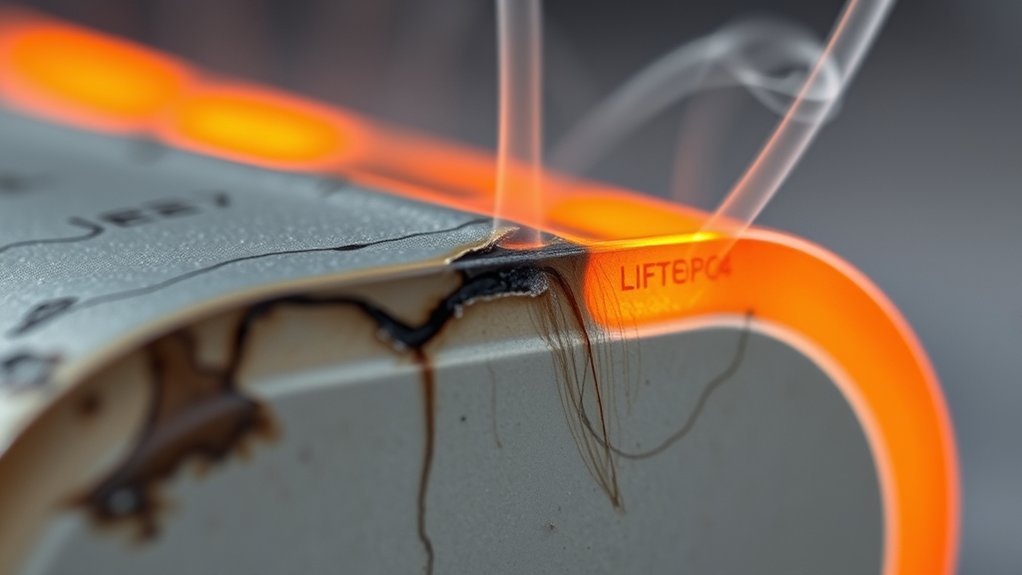
Thermal runaway in lithium-ion batteries occurs when internal heat generation exceeds dissipation, leading to uncontrollable temperature escalation. The root cause involves complex interactions between battery chemistry and energy density. Certain chemistries, such as high-energy-density formulations, release more heat during charge and discharge cycles, increasing the risk of thermal runaway. Elevated temperatures can cause electrolyte decomposition, electrode degradation, and internal short circuits. These processes generate additional heat, creating a feedback loop that accelerates temperature rise. Understanding the interplay between battery chemistry and energy density is vital, as higher energy densities often correlate with increased thermal risks. Effective thermal management and selecting chemistries with inherent stability are essential steps to mitigate runaway potential and guarantee battery safety.
Why LiFePO₄ Chemistry Offers Better Thermal Stability
What makes LiFePO₄ chemistry inherently safer and more thermally stable than other lithium-ion chemistries is its stable crystal structure, which resists decomposition at elevated temperatures. This stability reduces the risk of thermal runaway and associated safety hazards. Additionally, LiFePO₄’s lower operating voltage and high thermal endurance contribute to its safety profile. Its chemical composition also facilitates safer battery recycling processes, minimizing environmental impact by reducing toxic byproducts. The inherent thermal stability means less risk of catastrophic failure during thermal stress, and its environmentally friendly properties support sustainable disposal practices. Overall, LiFePO₄’s stable chemistry offers significant advantages in safety, environmental impact, and lifecycle management, making it a preferred choice for applications demanding reliable thermal stability.
Key Factors That Enhance LiFePO₄’s Resistance to Thermal Runaway
Several intrinsic properties of LiFePO₄ contribute to its notable resistance to thermal runaway. Its stable crystal structure limits thermal decomposition, prolonging battery lifespan and reducing risk. Environmental factors, such as temperature and humidity, influence this resistance by affecting reaction kinetics and material stability. To illustrate:
| Factor | Effect on Resistance |
|---|---|
| Material Stability | Enhances chemical integrity over time |
| Temperature Control | Maintains *ideal* conditions, reducing risks |
| Humidity Levels | Prevents moisture-induced degradation |
These factors work synergistically to bolster safety, with intrinsic material properties providing a robust foundation for thermal stability amid varying environmental conditions.
How Battery Design and Manufacturing Improve Safety and Stability
Design and manufacturing processes play a critical role in enhancing the safety and stability of LiFePO₄ batteries by optimizing internal structures and material integration. Strict adherence to manufacturing standards guarantees consistent quality, reducing the risk of defects that could lead to thermal instability. Advanced manufacturing techniques improve electrode uniformity and separator placement, mitigating hotspots and short circuits. Incorporating safety features like thermal barriers and pressure relief mechanisms further prevents thermal runaway. Additionally, designing batteries with recyclable components facilitates effective battery recycling, which minimizes environmental impact and reduces hazards associated with improper disposal. These measures collectively improve the inherent safety of LiFePO₄ batteries, making them more reliable for high-demand applications. Ultimately, meticulous design and manufacturing practices directly contribute to enhanced safety and stability throughout the battery’s lifecycle.
The Role of Operating Conditions in Preventing Thermal Runaway
Maintaining ideal temperature ranges is essential for preventing thermal runaway in LiFePO4 batteries, as elevated temperatures accelerate degradation and safety risks. Controlled charging practices, including current and voltage regulation, minimize thermal stress and chemical instability. By carefully managing operating conditions, we can considerably enhance battery safety and longevity.
Optimal Temperature Management
Effective temperature management is essential in preventing thermal runaway in Lifepo4 batteries, as operating conditions directly influence the thermal stability of the cells. Maintaining ideal temperatures minimizes risks associated with ambient cooling and reduces material degradation, which can compromise cell integrity. Proper thermal regulation ensures that the battery operates within a safe temperature range, preventing excessive heat buildup. By controlling environmental factors and internal temperatures, we can considerably lower the likelihood of thermal events.
Key measures include:
- Ensuring consistent ambient cooling in operating environments
- Monitoring internal cell temperatures regularly
- Avoiding exposure to extreme temperatures
- Using thermal management systems to dissipate heat effectively
- Limiting operational voltage and current to reduce heat generation
Implementing these strategies enhances the battery’s safety and longevity.
Controlled Charging Practices
Controlling charging practices is essential in maintaining safe operating conditions for Lifepo4 batteries, as improper charging can markedly increase the risk of thermal runaway. Following strict charging protocols ensures ideal current and voltage levels, reducing stress on the cells. Proper charging also influences battery recycling processes by preserving cell integrity and preventing hazardous degradation. Adherence to manufacturer specifications minimizes overcharging and temperature spikes, which are critical in thermal runaway prevention.
| Charging Parameter | Recommended Practice |
|---|---|
| Voltage Limit | Follow manufacturer’s maximum voltage |
| Current Rate | Use specified charge current |
| Temperature Range | Maintain within favorable temperature |
| Charging Cycles | Avoid deep discharges frequently |
| Monitoring | Employ real-time voltage and temperature checks |
Comparing Thermal Runaway Risks Between LiFePO₄ and Other Lithium-Ion Chemistries
We compare the thermal stability of LiFePO₄ with other lithium-ion chemistries to assess inherent safety differences. The effectiveness of safety mechanisms varies markedly between chemistries, influencing their risk profiles. Understanding these factors helps us evaluate the relative safety margins during thermal events.
Thermal Stability Comparisons
LiFePO₄ batteries exhibit particularly superior thermal stability compared to other lithium-ion chemistries, primarily due to their stable crystal structure and lower operating voltages. This inherent stability reduces the likelihood of thermal runaway under abnormal conditions. Compared to NMC or LCO chemistries, LiFePO₄ demonstrates:
- Higher thermal decomposition temperatures
- Lower risk of exothermic reactions
- Reduced propensity for internal short circuits
- Greater resilience to overcharging and overheating
- More environmentally friendly disposal and recycling processes
These factors contribute to a decreased environmental impact, especially concerning battery recycling. The reduced risk of thermal runaway not only enhances safety but also minimizes hazardous waste generation, supporting sustainable lifecycle management and mitigating potential ecological damage.
Safety Mechanisms Effectiveness
Safety mechanisms in lithium-ion batteries are essential for mitigating thermal runaway risks, especially when comparing different chemistries. LiFePO₄ batteries inherently possess higher chemical stability, reducing the likelihood of thermal runaway through robust thermal management and safety features. Manufacturing standards play a crucial role; strict adherence to quality controls minimizes defects that could compromise safety. Additionally, advanced battery recycling processes help prevent hazardous failures by safely handling degraded cells. Unlike other lithium-ion chemistries, LiFePO₄’s stable chemistry less often requires complex safety devices, but effective safety mechanisms remain indispensable across all chemistries. Overall, the combination of intrinsic material stability, rigorous manufacturing standards, and diligent recycling practices enhances the safety profile, making LiFePO₄ batteries more resistant to thermal runaway risks.
Practical Tips for Safely Using and Maintaining LiFePO₄ Batteries
To guarantee the safe operation and longevity of LiFePO₄ batteries, diligent maintenance and proper usage practices are essential. Regularly inspect connections for corrosion or damage, and ensure charging occurs within manufacturer-recommended voltage and temperature ranges. Use only chargers with appropriate specifications to prevent overcharging and thermal stress. Prioritize batteries with manufacturer certifications, confirming adherence to safety standards. When disposing of or recycling batteries, follow proper battery recycling procedures to prevent environmental hazards. Maintain balanced cells through periodic equalization charging, which minimizes thermal runaways. Store batteries in cool, dry environments and avoid exposure to direct sunlight or extreme temperatures. These practices reduce risks associated with thermal runaway and improve long-term performance.
What Advances Are Being Made to Further Reduce Thermal Runaway Risks
Recent advancements in battery technology and materials science are actively targeting the reduction of thermal runaway risks in lithium iron phosphate (LiFePO₄) batteries. Researchers are developing safer chemistries and integrated thermal management systems to mitigate heat generation during operation. Innovations in battery recycling techniques aim to remove residual contaminants and improve material purity, further enhancing safety profiles. These efforts support broader market adoption by addressing safety concerns and regulatory standards. Additionally, new separator materials and internal safety features are being incorporated to prevent internal short circuits that could trigger thermal runaway. Collectively, these advances create a more resilient battery ecosystem, fostering confidence among consumers and manufacturers while reducing the likelihood of thermal runaway incidents.
Frequently Asked Questions
How Does Ambient Temperature Affect Lifepo₄’s Thermal Stability?
Ambient temperature influences Lifepo4’s thermal stability by approaching temperature thresholds that increase risk. Higher temperatures impair heat dissipation, elevating thermal runaway potential, while lower temperatures enhance stability but reduce performance. We must monitor and manage these factors carefully.
What Is the Impact of Battery Age on Thermal Runaway Resistance?
We find that battery age, due to degradation, slightly reduces thermal runaway resistance, but ongoing safety improvements in Lifepo₄ cells counteract this effect, maintaining reliable thermal stability over the battery’s lifespan.
Can External Damage Cause Thermal Runaway in Lifepo₄ Batteries?
External impacts can indeed trigger thermal runaway in LiFePO₄ batteries if they compromise structural integrity, causing internal damage or short circuits. We emphasize careful handling and protective measures to maintain battery safety and prevent catastrophic failures.
How Do Manufacturing Defects Influence Thermal Stability?
Manufacturing defects compromise thermal stability by undermining manufacturing quality and material consistency, creating weak points susceptible to thermal runaway. Ensuring strict quality control and consistent materials enhances safety and maintains the battery’s thermal resilience.
Are There Specific Charging Protocols That Improve Safety?
Think of charging protocols as traffic rules that prevent accidents. Proper charging algorithms, combined with integrated safety features, reduce risks by controlling voltage and current, ensuring thermal stability and safeguarding against thermal runaway in Lifepo4 batteries.
Conclusion
In conclusion, LiFePO₄ batteries stand out for their superior thermal runaway resistance, thanks to their stable chemistry and thoughtful design. While no technology is completely risk-free, understanding these factors helps us operate and maintain batteries safely. As we continue advancing materials and manufacturing standards, we can stay ahead of potential issues. Ultimately, it’s about playing it safe and not putting all our eggs in one basket—because prevention is always better than cure.