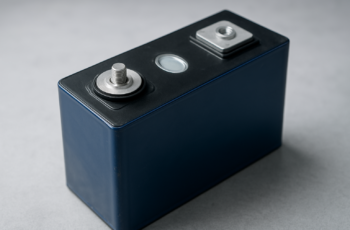
At the core of LiFePO₄ batteries lies a fortress of safety, built upon chemistry that resists thermal runaway and mechanical design that prevents internal failures. These features serve as a foundation, but understanding how they work together reveals much about the reliability of these power sources. As we examine their thermal management, BMS protections, and manufacturing standards, we uncover the layers that safeguard both users and assets—yet, the full scope of these safety measures warrants closer inspection.
Key Takeaways
- Lithium iron phosphate (LiFePO₄) cathodes offer high thermal stability, preventing combustion and reducing fire risk.
- Built-in thermal management and sensors regulate temperature, avoiding overheating during operation.
- Advanced Battery Management Systems (BMS) monitor voltage, current, and temperature, ensuring safe charging and discharging.
- Reinforced casing and internal separators prevent internal short circuits and protect against physical damage.
- Compliance with safety standards and certifications (UL, CE, IEC) verify long-term safety and durability.
How Do Lifepo4 Batteries Ensure Safety Through Chemistry?
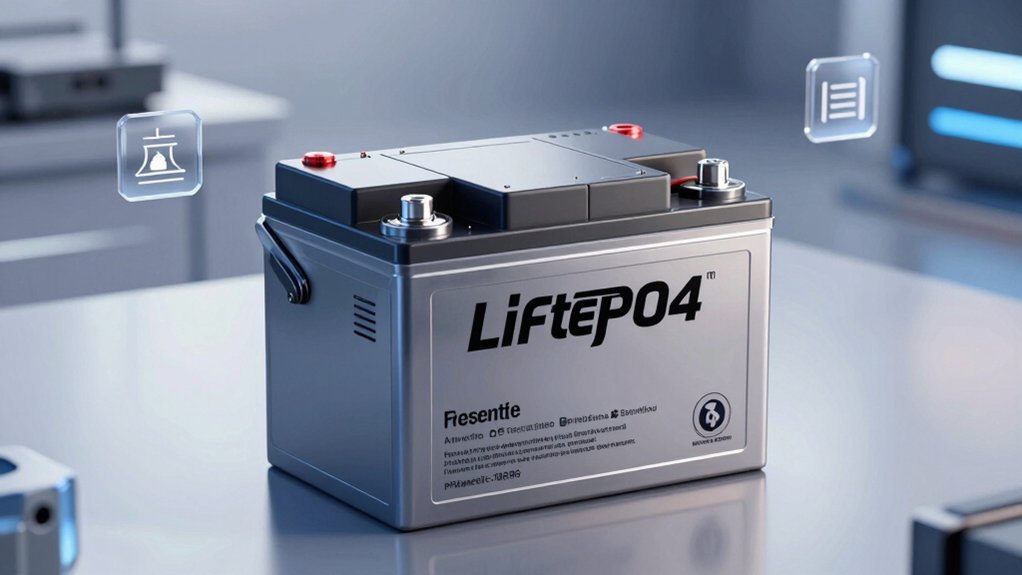
Lifepo4 batteries guarantee safety through their unique chemical composition, which inherently stabilizes their structure and reduces the risk of thermal runaway. This stability directly influences battery lifespan, allowing for consistent performance over extended cycles. The cathode material, lithium iron phosphate, exhibits high thermal stability, preventing combustion even under stress or damage. Consequently, these batteries have a lower environmental impact due to reduced risk of hazardous failures and longer operational life, minimizing waste and resource consumption. Their chemical stability also diminishes the likelihood of electrolyte decomposition, further enhancing safety and sustainability. Overall, the chemistry of Lifepo4 batteries ensures not only a safer operation but also contributes positively to environmental considerations by extending lifespan and reducing disposal frequency.
What Are the Built-In Thermal Management Features of Lifepo4 Cells?
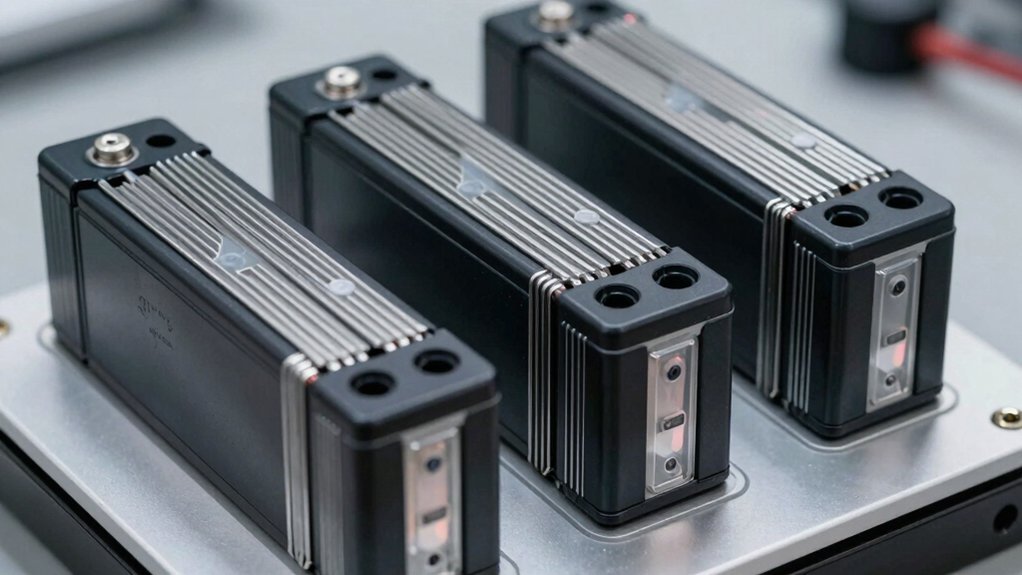
To maintain safety and optimize performance, Lifepo4 cells incorporate several built-in thermal management features that actively regulate temperature during operation. These features leverage thermal conductivity principles and efficient heat dissipation mechanisms to prevent overheating and thermal runaway. Specifically, Lifepo4 cells often include:
- High thermal conductivity materials within the cell structure, facilitating rapid heat transfer
- Design features that promote uniform heat dissipation across the cell surface
- Internal heat spreaders to distribute heat evenly and avoid hot spots
- Structural stability that minimizes temperature gradients during charge and discharge cycles
These integrated features guarantee that temperature remains within safe operational limits, reducing risks associated with thermal stress or failure, therefore enhancing overall battery safety and longevity.
How Does Battery Management System (BMS) Protect Lifepo4 Batteries?
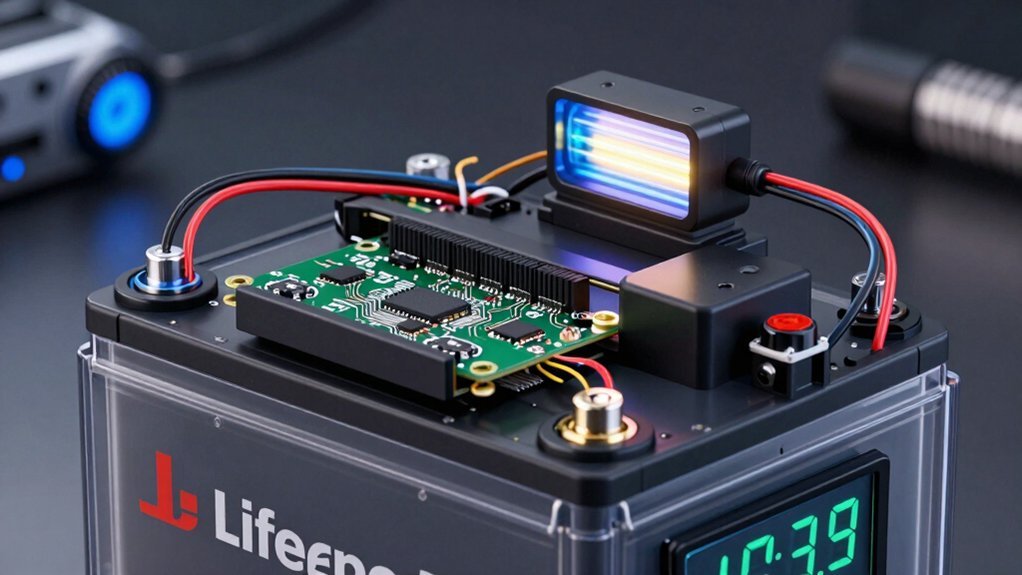
The BMS plays a critical role in safeguarding Lifepo4 batteries by continuously monitoring voltage and current levels to prevent overcharging and overdischarging. It also manages temperature fluctuations through integrated regulation systems, ensuring operation within safe thermal limits. By executing these functions, the BMS maintains ideal battery health and mitigates safety risks.
Overcharge and Overdischarge Prevention
How does a Battery Management System (BMS) effectively prevent overcharge and overdischarge in Lifepo4 batteries? It does so by continuously monitoring cell voltages and current flow, ensuring operation stays within safe limits. This regulation preserves battery lifespan and optimizes charging speed without risking damage. Key mechanisms include:
- Limiting charge voltage to prevent overcharge.
- Detecting low voltage levels to avoid overdischarge.
- Balancing cells to maintain uniform voltage.
- Shutting down the system during unsafe conditions.
These controls help sustain the battery’s integrity and performance over time. By preventing excessive voltage fluctuations, the BMS enhances overall safety and reliability, ultimately extending the functional life of Lifepo4 batteries while enabling efficient charging cycles.
Temperature Regulation Systems
Effective temperature regulation is essential for maintaining the safety and longevity of Lifepo4 batteries, complementing the BMS’s role in voltage and current management. The BMS employs thermal insulation to prevent rapid temperature fluctuations, ensuring uniform heat distribution and reducing thermal stress. Additionally, some systems incorporate fire-resistant casing materials that contain and isolate heat during thermal runaway events, minimizing fire hazards. These mechanisms work together to maintain ideal operating temperatures, preventing overheating or excessive cooling that can degrade battery performance or cause failure. Precise temperature monitoring enables the BMS to trigger protective measures, such as reducing charge rates or disconnecting the battery. Ultimately, these integrated temperature regulation strategies enhance safety by mitigating thermal risks inherent in battery operation, ensuring reliable performance over the battery’s lifespan.
Why Are Lifepo4 Batteries Less Prone to Overheating and Fires?
Because of their unique chemical composition, Lifepo4 batteries inherently resist overheating and fires more effectively than other lithium-ion chemistries. This stability stems from their robust cathode material, which reduces thermal runaway risk. Additionally, Lifepo4’s lower voltage per cell prevents excessive heat buildup. Its strong chemical bonds enhance thermal stability, minimizing degradation under stress. These attributes positively impact environmental impact by reducing fire-related hazards and toxic waste. They also foster broader market adoption, especially in safety-critical applications. Key factors include:
- Superior thermal stability reduces fire risk
- Reduced propensity for thermal runaway
- Lower operating temperatures limit overheating
- Enhanced chemical stability extends lifespan and safety
What Mechanical Design Elements Enhance Lifepo4 Safety?
Mechanical design elements play a crucial role in enhancing the safety of Lifepo4 batteries by physically containing and preventing conditions that could lead to failure. Ensuring mechanical integrity is fundamental; it involves selecting robust materials and precise manufacturing processes to resist deformation, vibration, and external impacts. Structural reinforcement, such as reinforced casing and internal separators, prevents internal short circuits caused by mechanical stress or damage. These design features help contain thermal and electrical anomalies, reducing the risk of catastrophic failure. By optimizing mechanical integrity and implementing effective structural reinforcement, we improve the battery’s resilience against mechanical failures, ultimately enhancing overall safety. This approach minimizes the potential for physical damage-induced hazards, ensuring the Lifepo4 batteries operate reliably under demanding conditions.
How Do Lifepo4 Batteries Prevent Overcharge and Overdischarge?
Lifepo4 batteries incorporate multiple safety mechanisms to prevent overcharge and overdischarge, ensuring reliable operation. Built-in overcharge protection circuits, sophisticated Battery Management Systems (BMS), and voltage regulation mechanisms work together to monitor and control cell voltage levels. These features enable the battery to maintain peak performance while safeguarding against potential damage.
Built-In Overcharge Protection
How do LiFePO4 batteries inherently prevent overcharge and overdischarge to guarantee safety and longevity? They incorporate built-in overcharge protection mechanisms that regulate voltage levels, ensuring peak operation and extending battery lifespan. These features prevent excessive voltage that could compromise cell integrity or cause thermal runaway, reducing environmental impact. Key aspects include:
- Voltage cutoff circuits that disconnect charging once maximum voltage is reached
- Current regulation to avoid damaging high current flows during overcharge
- Cell balancing to maintain uniform voltage across all cells, preventing overcharge in individual cells
- Thermal sensors that monitor temperature and inhibit charging if overheating occurs
This integrated protection minimizes reliance on external systems, improving safety and sustainability while safeguarding the battery’s performance over its lifespan.
Battery Management System (BMS)
A Battery Management System (BMS) plays an essential role in safeguarding LiFePO4 batteries against overcharge and overdischarge by actively monitoring and controlling cell voltages and currents. It guarantees each cell remains within safe voltage thresholds, preventing damage that could compromise battery longevity or safety. By managing charge and discharge processes, the BMS preserves the battery cycle life, enhancing overall durability. Additionally, it balances cell voltages to maintain uniform energy density across the pack, preventing localized overcharge or overdischarge that could lead to thermal issues. This precise regulation is critical for high energy density applications, where maintaining peak performance and safety is paramount. Through these controls, the BMS effectively extends the usable life of LiFePO4 batteries and improves their safety profile.
Voltage Regulation Mechanisms
To effectively prevent overcharge and overdischarge, LiFePO4 batteries employ sophisticated voltage regulation mechanisms that actively monitor cell voltages in real-time. These systems ensure voltage stability by dynamically adjusting current flow, preventing voltage spikes or drops that could damage the battery. Key features include:
- Real-time voltage monitoring across individual cells
- Current regulation to limit excessive charge or discharge rates
- Automatic cut-off when voltage thresholds are approached
- Integration with the Battery Management System (BMS) to optimize safety and performance
These mechanisms maintain voltage stability through precise current regulation, reducing stress on the cells and extending battery lifespan. By continuously balancing cell voltages, Lifepo4 batteries effectively mitigate risks associated with overcharge and overdischarge, ensuring reliable and safe operation.
What Role Do Cell Balancing and Equalization Play in Safety?
Cell balancing and equalization are critical processes that directly impact the safety of LiFePO4 battery systems by ensuring uniform voltage levels across individual cells. Proper balancing prevents overcharging or deep discharging of specific cells, which can lead to thermal runaway, reduced battery lifespan, and environmental hazards. Balancing techniques—passive or active—maintain cell voltage consistency, enhancing overall system stability. This reduces the risk of cell degradation and prolongs operational life, benefiting both safety and sustainability. The following table summarizes key aspects:
| Aspect | Function | Impact on Safety |
|---|---|---|
| Voltage Equalization | Balances cell voltage levels | Prevents thermal runaway |
| Current Flow | Facilitates uniform charge/discharge | Minimizes cell stress |
| Monitoring | Detects imbalance early | Enables preventative measures |
| Environmental Effect | Reduces waste, extends battery life | Less frequent replacements |
How Do Manufacturing Standards and Quality Control Contribute to Safety?
Manufacturing standards and quality control processes serve as foundational elements that directly influence the safety and reliability of LiFePO4 batteries. Strict adherence to industry benchmarks guarantees consistent cell performance, minimizing risks like thermal runaway. These standards include rigorous testing for voltage stability, cycle life, and thermal management. Quality control measures, such as automated inspection and precise assembly, reduce defect rates that could lead to safety hazards. Additionally, standardized production enhances battery recyclability, reducing environmental impact by facilitating safer disposal and reuse. Ensuring high manufacturing quality also prevents impurities that could compromise safety and sustainability. Ultimately, robust standards and controls promote safer operation, responsible battery recycling, and a reduced ecological footprint, reinforcing the importance of quality in advancing safe, environmentally conscious energy storage solutions.
What Maintenance Practices Maximize the Lifepo4 Battery’s Safe Operation?
Regular inspection and cleaning of Lifepo4 batteries are essential to identify potential issues early and prevent safety hazards. Adhering to proper charging practices guarantees peak performance and minimizes risks associated with overcharging or deep discharging. Implementing these maintenance routines enhances the battery’s safety and longevity.
Regular Inspection and Cleaning
Maintaining the safety of LiFePO4 batteries requires consistent inspection and cleaning to prevent potential failures that could compromise battery capacity and reduce charging cycles. Regular checks should focus on detecting corrosion, loose connections, or physical damage. Cleaning involves removing dirt and corrosion from terminals to ensure maximum conductivity. Key practices include:
- Inspecting terminal connections for corrosion and tightness
- Cleaning terminals with a soft brush and approved cleaning agents
- Checking for swelling, cracks, or leaks in the battery casing
- Monitoring for signs of overheating or unusual odors
These steps help maintain reliable performance, prevent internal short circuits, and extend the overall lifespan, guaranteeing safe operation over multiple charging cycles. Proper maintenance emphasizes the importance of early detection for avoiding safety hazards.
Proper Charging Practices
Proper charging practices are fundamental to ensuring the safety and longevity of LiFePO4 batteries. Correct battery installation is essential, as improper connections can lead to short circuits or thermal runaway. We recommend using chargers specifically designed for LiFePO4 chemistry, with appropriate voltage and current limits. Overcharging risks damaging the battery and compromising user safety, so implementing a reliable BMS (Battery Management System) safeguards against overvoltage conditions. Additionally, maintaining ideal ambient temperature during charging enhances safety and performance. Regularly verifying charger functionality and adhering to manufacturer guidelines helps prevent hazards. Proper charging procedures not only extend battery lifespan but also mitigate risks associated with electrical faults, ensuring safe operation for users and preserving the integrity of the battery system over time.
How Do Safety Certifications and Testing Validate Lifepo4 Battery Security?
Safety certifications and rigorous testing procedures serve as essential benchmarks for validating the security of LiFePO4 batteries. These assessments guarantee batteries meet strict standards, aligning with market trends toward safer, more reliable energy storage solutions. Certifications like UL, CE, and IEC verify compliance with safety and environmental impact regulations. Testing includes thermal stability, overcharge, short circuit, and mechanical abuse simulations, providing data on failure modes and safety margins.
- Verify resistance to thermal runaway and fire hazards
- Ensure durability during mechanical stress tests
- Confirm environmental safety and minimal toxic emissions
- Validate long-term performance and reliability
These measures build consumer confidence and influence market adoption, emphasizing the importance of safety certifications in balancing security with sustainability.
Frequently Asked Questions
How Do Lifepo4 Batteries Handle Extreme Temperature Conditions Safely?
We guarantee safe operation in extreme temperatures through effective temperature regulation and thermal protection systems, which monitor and control battery heat levels, preventing thermal runaway and damage, consequently maintaining performance and safety under harsh environmental conditions.
What Are Common Signs of Potential Lifepo4 Battery Safety Issues?
We observe signs like swelling, overheating, or unusual voltage drops, which may indicate safety issues rooted in battery manufacturing flaws or safety regulation breaches; early detection is crucial for preventing failures and ensuring safe operation of LiFePO4 batteries.
Can Lifepo4 Batteries Be Safely Recycled or Disposed Of?
Recycling Lifepo4 batteries is essential to prevent environmental catastrophe, and proper disposal safety guarantees hazardous materials are contained. We recommend following strict battery recycling protocols and consulting local regulations to manage Lifepo4 batteries responsibly and sustainably.
How Do External Physical Damages Impact Lifepo4 Battery Safety?
Physical damage compromises battery integrity, increasing risks of internal short circuits and thermal runaway. We analyze the extent of damage carefully, as compromised integrity can lead to dangerous failures, emphasizing the importance of inspecting external damages for safety.
Are There Specific Safety Concerns for Lifepo4 Batteries in Cold Climates?
In cold climates, Lifepo4 batteries face safety concerns like reduced capacity and potential internal damage, emphasizing the importance of adhering to manufacturing standards and monitoring battery shelf life to guarantee safe, reliable operation under extreme conditions.
Conclusion
In essence, LiFePO₄ batteries are like a well-guarded fortress—carefully designed with multiple safety layers to prevent vulnerabilities. Our experience shows that rigorous chemistry, thermal management, and quality standards act as the walls and gates protecting against failures. Just as a fortress withstands storms, these safety features ensure reliable, secure performance even under demanding conditions. By understanding these mechanisms, we can trust LiFePO₄ batteries to power our future safely and sustainably.