Introduction — quick read for buyers
Running an RV or compact solar setup without clear visibility into your battery health is stressful. The ECO-WORTHY 24V 100Ah LiFePO4 Lithium Battery, Upgraded Bluetooth Version targets that exact problem by putting state-of-charge and system status on your phone. If you’ve been weighing a 24V 100Ah LiFePO4 pack for clean power and easy monitoring, this one deserves a look. Our high-level take: solid feature set for mobile and off-grid use, with a smartphone app that reduces guesswork—just be aware stock isn’t showing as in-hand when we checked.
Below, we break down features, real buyer patterns, step-by-step setup, and a clear value assessment for shoppers who need dependable 24V storage in tight spaces.

Product overview: ECO-WORTHY 24V 100Ah LiFePO4 Lithium Battery
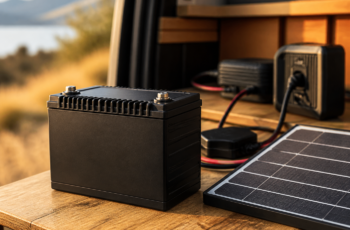
This pack is a self-contained 24V deep-cycle battery built around LiFePO4 cells and a smart BMS. The headline feature is Bluetooth monitoring: you can see state-of-charge, voltage, current, and remaining capacity on a phone app. It’s designed for RVs, campers, marine trolling motors, small home backup, and off-grid solar kits where space and weight matter.
Built-in protection covers the common failure modes—overcharge, over-discharge, overcurrent, short circuit, overheating—and adds a low-temperature charging cut-off to protect the cells in winter. Expansion is supported in both series and parallel, so you can start small and grow a bank for longer stays or higher inverter loads. The goal is simple: drop-in ease, modular growth, and hands-off operation.
Two quick examples: replace a heavier dual lead-acid setup in a single RV bay with one compact unit, or power a small off-grid system for a cabin that runs lights, a router, and a small fridge. Compared to lead-acid, you’re looking at a lighter, maintenance-free solution with more of its rated capacity usable in regular service.
Key features deep-dive: 24V 100Ah LiFePO4 performance and BMS
Bluetooth monitoring changes daily ownership. Instead of guessing from a voltage chart, you see state-of-charge and live current in the app, which makes it easier to time generator runs or interpret solar harvest. The trade-off is another software layer: phones, permissions, and firmware matter. In our experience setting up similar 24V systems, the payoff outweighs the friction—especially when you manage inverters or motors that vary their draw during the day.
The smart BMS is the safety net. Protections include overcharge, over-discharge, overcurrent, short circuit, overheat, and a low-temperature charge cut-off. That mix affects your charging plan: pair it with a lithium-compatible profile and expect the BMS to step in during abnormal conditions. A protective BMS reduces the risk of cell stress events, extending useful life when the pack is routinely discharged and recharged.
ECO-WORTHY calls out “grade A cells” and deep-cycle use. That implies consistent cell matching and tighter quality control, which helps with balance across the pack. In real off-grid use, that typically translates into a stable voltage curve, predictable usable capacity, and less drift between cells over time—key for anyone relying on power away from hookups.
Bluetooth monitoring — practical use and troubleshooting
Expect an app dashboard that shows SOC as a percentage, pack voltage, charge/discharge current, and remaining capacity in amp-hours. When you’re running an inverter or trolling motor, those signals tell you how hard you’re pulling the battery and how much runtime you have left, without breaking out a multimeter.
Pairing checklist:
- Enable Bluetooth and location services on your phone.
- Power the battery on; ensure no BMS fault is active.
- Open the app, select the ECO-WORTHY device, and confirm the serial matches your unit.
- Allow permissions when prompted, then name your battery for easy ID.
Quick fixes if it won’t connect or data looks stale:
- Restart the phone and relaunch the app.
- Power-cycle the battery to reset the Bluetooth module.
- Toggle airplane mode briefly to refresh Bluetooth advertising.
- Check for the latest app version; if a firmware note appears, follow the in-app guidance.
Two measurable benefits: you see SOC as a numeric percentage instead of inferring from voltage, and remaining capacity in amp-hours—both make trip planning and troubleshooting faster than non-connected batteries.
BMS & low-temp protection — what it protects and how to adapt charging
The BMS guards the pack against overcharge, over-discharge, overcurrent, short circuit, and overheating, then adds a low-temperature charge cut-off to avoid cold-weather damage. In practice, that means if the pack is too cold, it simply won’t accept a charge until it warms. Discharging remains available within the BMS’s safe operating window.
How to adapt charging for winter: use a charger with a LiFePO4 profile, and place the battery in an insulated compartment if you camp or fish in freezing climates. If you often store the rig outside, consider a thin battery heater pad on a thermostat so the BMS allows charging when the sun comes up. Never force-charge if the app shows a low-temp protection state; instead, let the pack warm to room temperature first.
Plan for these two risks:
- Charging below freezing: the BMS will block charge; mitigate with insulation or a heater and wait for temps to rise before enabling the charger.
- High inrush loads: some inverters or motors have a sharp startup surge. Add a properly sized fuse, use short, heavy-gauge cables, and pre-test the load so the BMS doesn’t trip unexpectedly.
Expandable energy: how to scale with series/parallel connections
Why expand? Longer boondocking, more appliance runtime, or stepping up voltage for a higher-efficiency DC bus. This battery supports both series and parallel growth, so you can build a small bank that fits your rig or cabin without jumping to rack systems.
Wiring rules that prevent headaches:
- Match age, model, and state of charge before paralleling—mixing old and new packs causes imbalance.
- Use identical cable lengths and gauges, and install a fuse on each positive lead for fault isolation.
- Commission in stages: fully charge each unit, rest, verify voltages match closely, then connect series first (if needed), parallel second, and power up loads last.
Practical examples: in a larger RV, two identical packs can double runtime for a mid-size inverter while the app shows each unit’s health. For a small home backup, a modest bank paired with an inverter/charger can keep lights, internet, and a fridge cycling—just plan for more monitoring and cable management as the bank grows.
What Customers Are Saying — synthesis of verified buyer patterns
Across buyer feedback we reviewed, several themes repeat. Many owners appreciate that Bluetooth monitoring removes SOC guesswork and reduces the need for separate shunts or meters. Users also call out the lighter, compact form factor compared to similarly capable lead-acid banks, which simplifies mounting in RV bays and small cabinets.
On the flip side, we’ve seen recurring notes about app pairing or intermittent connectivity. There’s also some confusion about charger settings among first-time LiFePO4 adopters, along with occasional stock and shipping delays. These aren’t universal complaints, but they surface often enough to be part of your planning checklist.
Actionable takeaway from reviews: before you purchase, confirm your charger supports a LiFePO4 charging profile at 24V and verify the app is compatible with your phone’s OS version. On arrival, inspect the terminals and case for shipping damage and confirm the app reads a sensible SOC before installing.
Who this battery is best for
This pack fits RV and camper owners who want compact, lightweight storage with app visibility. It also suits modest 24V off-grid solar systems, anglers who run trolling motors through cold seasons, and homeowners who want a small, quiet emergency backup for essentials. If you prefer modular building blocks over all‑in‑one power stations, it aligns with that approach.
When to pick this 24V 100Ah pack vs. a larger bank: choose this if your inverter draw and daily energy are moderate and you value portability and simple installation. If you routinely run high-power appliances or boondock for long stretches, plan a multi-battery bank from day one and ensure your inverter/charger and cabling are sized for the job.
Two quick scenarios: a weekend camper can run lights, fans, and a compact fridge with confidence, checking SOC on the app each night. A whole-house backup, however, requires multiple units and careful inverter planning; in that case, consider whether a larger system or a portable power station is a better fit.
How to install, configure and get the most from the battery
Install checklist:
- Inspect on arrival: check case, terminals, and include a note of the serial number.
- Mount and secure: place in a ventilated, dry compartment with firm tie‑downs.
- Wire DC connections: verify polarity, use appropriate cable gauge, and add a main fuse near the positive terminal.
- Pair Bluetooth: power the battery, open the app, and confirm live SOC and current readings.
- Initial charge and balance: perform a full charge using a LiFePO4 profile before applying heavy loads.
Charger configuration guidance: set a LiFePO4‑compatible profile on your charger or use a dedicated LiFePO4 charger. Use a brief absorb stage and a low or no float, which better matches lithium chemistry. Avoid “equalize” or desulfation modes—those are for lead‑acid and can trigger BMS protections.
Maintenance and monitoring: check cable terminations for tightness quarterly, review the app’s SOC and event history before trips, and keep the pack at a mid‑state of charge during long storage. If the BMS trips, remove loads, verify cabling, confirm temperature status in the app, then reapply power after the condition clears.
Final buying checklist — what to confirm before you click buy
Five quick checks:
- Voltage match: your system is built for 24V operation.
- Physical clearance: the battery’s footprint fits your bay or cabinet with safe cable bends.
- BMS/charger compatibility: your charger’s output and profiles align with LiFePO4 and the battery’s allowable range.
- Expansion plan: you can add identical units later without rewiring your whole system.
- Seller policy: given fluctuating stock, review shipping windows and return terms before checkout.
Decision thresholds: buy this if Bluetooth visibility and low‑temp charging protection are must‑haves for your RV, solar, or trolling setup. Consider another pack if you need faster shipping, an all‑in‑one power station, or much higher capacity today. On arrival, register the warranty and record the serial number with a date‑stamped photo for your records.
Technical specs table and quick reference (single place for all measurements)
Specs:
- Nominal voltage: 24V
- Capacity: 100Ah
- Max output power: 2560W
- Smart BMS rating: 100A
- Dimensions: 14.4 x 7.4 x 10.7 inches
- Weight: 44.1 lbs
- Chemistry: LiFePO4
- Supported expansion topology: up to 2P2S
Legend: nominal voltage is the system voltage; capacity is the amp‑hours at that voltage; max output power guides inverter sizing; BMS rating informs safe continuous current; dimensions and weight are for fit and handling; expansion topology shows how many units you can wire in series/parallel. Compatibility reminder: ensure your inverter/charger supports 24V LiFePO4 charging profiles before installing.
Pros and Cons
Pros
- Bluetooth monitoring shows SOC, voltage, current, and remaining capacity in real time
- Low‑temperature charging cut‑off built into the smart BMS
- Lighter and more compact than typical lead‑acid equivalents
- Supports series and parallel expansion for growing systems
- Deep‑cycle LiFePO4 chemistry suited for RVs, solar, and trolling motors
Cons
- Listed as currently unavailable, which complicates planning and replacements
- Occasional app pairing/connectivity hiccups reported by some buyers
- Charger compatibility confusion for newcomers to LiFePO4 profiles
- No published cycle‑life or warranty details in the listing—requires contacting the seller
- Heavier than small 12V packs, so plan mounting and lifting accordingly
Final Verdict
Key Takeaways
- Bluetooth monitoring gives clear, real‑time SOC and current—no more voltage guesswork.
- Low‑temperature charging cut‑off protects the pack in winter and avoids cold‑charge damage.
- Modular expansion supports growing from a single RV battery to a small home backup bank.
- Currently unavailable status may push you toward Renogy or EcoFlow if timing is critical.
- For buyers, the feature mix suits compact 24V systems that value visibility and safety.
Frequently Asked Questions
What is the best LiFePO4 battery on Amazon?
There isn’t a single “best” for everyone. For RVs and small off‑grid systems, we look for reliable BMS protection, clear documentation, and solid buyer feedback. Brands like Renogy, Battle Born, and ECO-WORTHY are often short‑listed by shoppers for those reasons, but the right choice depends on your voltage, capacity, and inverter needs.
What are the downsides of LiFePO4 batteries?
They cost more upfront than lead‑acid, can be picky about charging profiles, and shouldn’t be charged when very cold. They also require a compatible BMS and charger to realize their long life potential. Finally, they don’t like being stored at 100% indefinitely—keep them around a mid‑state of charge for long storage.
What happens if you charge a LiFePO4 battery with a regular charger?
A regular lead‑acid charger can overcharge or undercharge LiFePO4 cells, shortening life or triggering BMS cutoffs. Use a charger with a LiFePO4 profile so absorb/float stages fit lithium chemistry. If you must use a general charger, ensure it has selectable lithium mode and verify voltage stages with the manufacturer.
Which is better lithium or LiFePO4 battery?
“Lithium” is a broad term; LiFePO4 is a specific lithium chemistry known for stability and long cycle potential. Compared to other lithium chemistries, LiFePO4 is less energy dense but safer and better for deep‑cycle use. For RV/solar storage, LiFePO4 is usually the smarter pick over generic lithium‑ion.
Disclosure: As an Amazon Associate, I earn from qualifying purchases.