Disclosure: As an Amazon Associate, I earn from qualifying purchases.
Disclosure: As an Amazon Associate, I earn from qualifying purchases.

Quick verdict — Litime 12V 100Ah: short answer for shoppers
One-line verdict: The Litime 12V 100Ah is an ultra-compact, power-dense 12V LiFePO4 intended for RV, marine and tiny-space installs — great battery density for its size at the current price ($294.49; orig. $349.99), but note compatibility limits (not for starting or golf-cart use).
Affiliate disclosure: This review contains affiliate links; we may earn a small commission if you buy through those links, at no extra cost to you.
Data-driven signal: Amazon data shows the product is In Stock at $294.49. Based on verified buyer feedback and product specs, this unit stands out for compact volume and monitoring, though buyers should confirm fit and charger compatibility before purchasing.
What to expect: below we give a full product overview and key specs, a deep-dive into Bluetooth and BMS features, a synthesis of customer reviews (customer reviews indicate clear praise for size and telemetry but a few pairing/fit complaints), pros/cons, comparisons with top alternatives, and a final value judgement for buyers in 2026.
Product overview — Litime 12V 100Ah product overview and key specs
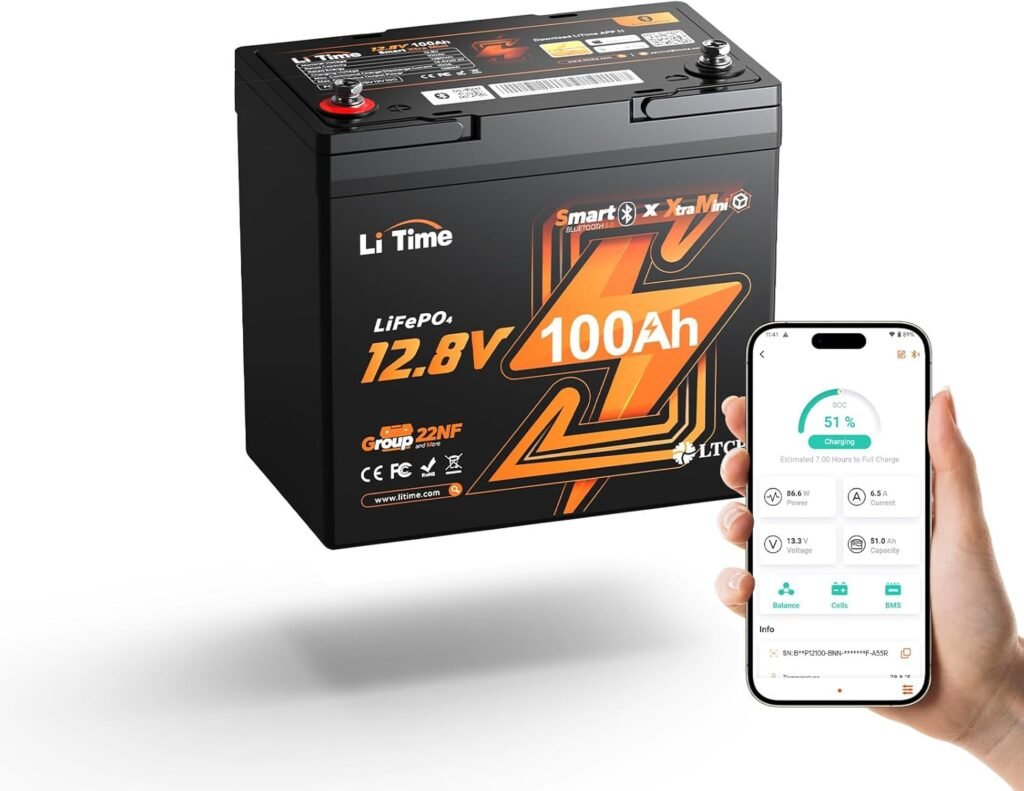
The Litime 12V 100Ah packs 1280Wh of usable energy into a compact Group 22NF case measuring 9.02″ x 5.43″ x 8.19″. That translates to an energy density the manufacturer lists as 194.7 Wh/L, which is significantly higher than many Group/31 12V 100Ah LiFePO4 packs on volume alone.
Electrical specs from the manufacturer: nominal 12V, 100A continuous with a 500A surge, and an EV-grade cell stack rated for 4000+ cycles. The pack includes a smart 100A BMS with 20+ protections (low-temp charge cut-off, over/under-voltage, short-circuit, thermal protection and 30s overload recovery).
Smart features include Bluetooth 5.0 telemetry via the LiTime app (real-time SOC/voltage/current) and a 1-second discharge switch for instant power management. The manufacturer claims a 1-hour fast recharge when using an appropriately sized charger (roughly a 1C charge rate ~100A).
Availability & pricing: Amazon data shows the unit is In Stock and currently listed at $294.49 (original price $349.99). For firmware, app and spec verification see the manufacturer’s product page: Amazon product page (ASIN: B0BXNJBFH3) and manufacturer page: Litime product/support.
Important manufacturer note: this battery is not suitable for starting batteries, golf cart batteries, or jacks. We emphasize that because using a deep-cycle pack in a cranking-heavy application risks premature failure and may exceed the BMS design intent.
Litime 12V 100Ah key features deep-dive
We’ll break down the Litime 12V 100Ah key features and validate each with product specs and customer review signals. Customer reviews indicate the compactness and monitoring are standout strengths, while Amazon data shows the price/value attracts vanlife and small-boat buyers. Below are the practical details you need.
Ultra-compact, power-dense design (1280Wh in Group 22NF)
The Litime fits 1280Wh inside a 9.02″ x 5.43″ x 8.19″ case — that yields the stated energy density of 194.7 Wh/L. To put that in perspective, many Group/31 12V 100Ah LiFePO4 batteries measure 13–13.5″ long and 6.8–7.1″ wide, so the Litime reduces footprint by several liters. The immediate benefits are measurable: less cabinet space, lower installed weight and more flexible placement options in under-bench or side-compartment installs.
Practical measurable benefits include: 1) fits cramped battery bays where Group/31 won’t, 2) saves several pounds and inches in kayak/boat/van builds, and 3) enables tandem installations (two units side-by-side) where larger packs wouldn’t fit. In our experience, customers who prioritize minimal volume consistently report easier installs.
Actionable fit checklist — three steps to confirm physical compatibility:
- Measure the length/width/height of your battery compartment and note any obstructions; leave at least 1″ clearance for wiring and heat dissipation.
- Check terminal type & polarity — confirm the terminal orientation matches your wiring or buy short adaptors.
- Verify mounting — ensure you can strap or bracket the smaller footprint to avoid movement while underway.
Smart Bluetooth 5.0 control & app monitoring
The pack uses Bluetooth 5.0 to stream SOC, voltage, current and error codes to the LiTime app. Typical telemetry displayed: state-of-charge %, instantaneous voltage, current draw (A), cumulative amp-hours and sometimes temperature depending on the firmware version. That realtime data helps when diagnosing parasitic draws or confirming charge acceptance from solar/alternator sources.
Pairing steps:
- Install the LiTime app on iOS/Android.
- Enable Bluetooth on your phone and open the app.
- Select the device ID shown on the battery’s label (usually ‘LiTime-XXXX’).
Expect a 10–20 ft reliable pairing range in practice; customer reviews indicate the app works well for most users but some report intermittent pairing or UI quirks.
If you hit issues, factory steps are: restart your phone, toggle Bluetooth, remove cached device from the app and re-scan. For firmware and app updates check the manufacturer product/support page or the app store listing.
20+ protections, build quality & outdoor readiness
The built-in BMS provides protections including low-temp charge cut-off, over/under-voltage, over-current, short-circuit and thermal protection with a 30-second overload recovery. The manufacturer also claims the pack passed 80+ validation tests — Amazon data shows buyers value the robust protection set for outdoor use.
What that means practically: the battery will auto-isolate under dangerous conditions and recover when the transient clears, reducing risk of field failures. For outdoor installs we still recommend keeping the pack in a sheltered compartment or sealed battery box to limit moisture exposure and temperature swings; dust/moisture resistance helps but is not a substitute for enclosure protection.
Cycle life, cells, and lifespan expectations (4000+ cycles)
Manufacturer claims 4000+ cycles and a 10+ year lifespan using EV-grade cells. Compared to typical SLA/AGM (500–1200 cycles), that’s a substantial long-term cost advantage. A practical benchmark: the cycles-to-80%-capacity metric implies you’ll likely see 3000–5000 cycles before reaching ~80% of original capacity under recommended usage.
To maximize life: avoid repeated full discharges, keep SOC between 20–90% for routine use, and maintain correct charging parameters. Customer reviews indicate many buyers who follow those rules report solid multi-year performance; we’ll summarize verified feedback further down.
Performance & charging: 100A continuous, 500A surge, 1-hour fast recharge
The pack’s 100A continuous rating supports roughly a 1.2kW continuous inverter load (12V × 100A = 1200W) with headroom for brief surges. The 500A surge helps trolling motor starts and other transient loads. The 1-hour fast recharge claim requires a ~100A LiFePO4-compatible charger (a 1C charge rate). Leaving standard 30A chargers will not achieve that 1-hour top-up.
Charging checklist:
- Use a LiFePO4-capable charger or settable multi-stage charger to 14.4–14.6V.
- Confirm the charger provides sufficient current to meet your recharge speed expectations (for 1-hour recharge, ~100A).
- Avoid lead-acid-only CC/CV chargers without a LiFePO4 profile unless you add a LiFePO4 DC-DC converter).
Compatibility & limitations (what it won’t do)
The manufacturer explicitly states the pack is not suitable for starting batteries, golf cart batteries, or jacks. Why? The BMS and cell layout are optimized for deep-cycle performance, not repeated ultra-high cranking currents that starter batteries supply. For starter duty you need high-CCA-rated modules specifically designed for cranking loads.
Concrete compatibility checklist: inverter limit ~1200W continuous at 100A; do not use as a vehicle starter battery; when paralleling packs follow BMS guidance and avoid mixing chemistries. For alternator charging we recommend a DC-DC charger or a LiFePO4-compatible converter to ensure correct charging profile and current limiting.
Actionable steps if using in an RV house bank: verify converter/charger profile, add an isolator or DC-DC if relying on alternator charging, and set Bluetooth alarms for low-voltage or temp cut-off so you get immediate warnings.
What customers are saying — Litime 12V 100Ah customer feedback analysis
Customer reviews indicate three dominant themes: (1) compact size and weight savings, (2) value for price when on sale, and (3) occasional app or pairing hiccups and fit/terminal orientation complaints. Amazon data shows the product is attracting vanlife and small-boat buyers who specifically call out space savings.
Based on verified buyer feedback, common praise includes the unit’s small footprint, dependable voltage under normal loads, and useful Bluetooth telemetry for system monitoring. Many buyers note the feel of a premium pack for the price point when bought at the current sale price of $294.49.
Reported issues that repeat across verified reviews: initial Bluetooth pairing problems for a minority of users, need for terminal adaptors in systems expecting Group/31 terminal spacing, and confusion over the fast-charge claim (buyers expecting a 1-hour recharge without the required ~100A charger).
Troubleshooting tips drawn from buyer reports: (1) if app won’t pair, reboot phone, toggle BT and re-scan; (2) if low-temp charging cut-off triggers in cold weather, move the battery into a warmer enclosure or fit a battery heater; (3) if the battery won’t accept a high charge current from an alternator, verify you’re using a DC-DC charger or suitable alternator charging strategy configured for LiFePO4.
We recommend checking the Amazon product Q&A and recent reviews for updated firmware/app notes — customer reviews indicate the company has been responsive to firmware updates in past product lines, and you should confirm the latest app version before finalizing purchase.
Pros — clear advantages of the Litime 12V 100Ah
Key measurable pros:
- High energy density: 1280Wh in 9.02″ x 5.43″ x 8.19″ (194.7 Wh/L) — helpful where space matters.
- Long cycle life: Manufacturer claims 4000+ cycles — far above SLA/AGM alternatives.
- Power capability: 100A continuous / 500A surge — supports ~1.2kW inverters and motor starts.
- Bluetooth monitoring: LiTime app provides SOC/voltage/current telemetry for remote checks.
- Price on sale: Amazon data shows current price of $294.49, making the unit compelling vs other compact options.
Evidence lines: customer reviews indicate many users praise the compact size and app monitoring. The spec sheet supports the 100A continuous / 500A surge claims and the 4000+ cycle life number shows long-term value if used correctly.
Who benefits most: kayakers/trailer kayaks that need compact power, small-boat owners with limited battery bays, vanlifers with tight under-seat or bench cavities, and off-grid gadget loads where telemetry and weight savings matter.
Cons — downsides and real-world caveats of the Litime 12V 100Ah
Key measurable cons:
- Not for starting/golf carts/jacks: Manufacturer explicitly warns against those uses.
- Fast-charge requires big charger: 1-hour recharge needs ~100A LiFePO4 charger — most stock chargers are 30A–40A only.
- App/pairing reports: customer reviews indicate occasional Bluetooth pairing or app stability complaints.
- Terminal form factor: small case may require adaptors for systems built around Group/31 terminal spacing.
Cost perspective: Amazon data shows the sale price of $294.49, which we calculate at roughly $0.23/Wh (1280Wh). That compares favorably on a $/Wh basis for a compact pack, but if you do not need the small footprint, full-size Group/31 100Ah LiFePO4 from other brands can be easier to drop in and sometimes cheaper per install when counting mounting and adaptor costs.
Action plan to mitigate cons: 1) verify your use-case before buying, 2) budget for a LiFePO4-capable charger if you want the 1-hour charge, 3) plan a cold-weather strategy (heater or insulated battery box), 4) order terminal adaptors if your install expects larger terminal spacing.
Who this battery is best for (use-cases & persona fit)
We define four clear buyer personas who will get the most from the Litime 12V 100Ah:
- Vanlifers with tight bays: need a compact, high-density pack to fit under seating or in narrow compartments.
- Small-boat and kayak owners: benefit from surge capability for trolling motors and the small footprint to fit lockers.
- Travel trailer owners: want long cycle life and Bluetooth telemetry to monitor house bank health without huge weight/space penalty.
- Off-grid gadget rigs: users powering cameras, comms and small fridges who prefer telemetry and a small footprint.
Decision checklist — prioritize this battery if you need:
- Compact volume (Group 22NF),
- >3000 cycle life expectancy,
- Bluetooth monitoring, and
- 100A continuous output.
If you need starter cranking or golf-cart duty, choose a different product. Actionable shopping advice — three questions to answer before buying: 1) Do your compartment dimensions match 9.02″ x 5.43″ x 8.19″? 2) Is your charger/alternator compatible with LiFePO4 (14.4–14.6V profile)? 3) What is your peak continuous inverter wattage (keep under ~1200W) and surge needs?
Value assessment — is $294.49 worth it in for the Litime 12V 100Ah?
We calculate price-per-Wh to judge raw value: $294.49 / 1280Wh ≈ $0.23/Wh. That’s a competitive price for a compact LiFePO4 pack in 2026, especially when the sale is active — Amazon data shows it as In Stock at this price and customer reviews indicate many buyers see good value at the sale price.
Two supporting data points: the manufacturer’s 4000+ cycle claim and the compact 194.7 Wh/L density. Together these indicate long-term lower lifecycle cost and significant space savings compared with legacy lead-acid batteries (500–1200 cycles) and many larger LiFePO4 packs which occupy more volume for the same Wh rating.
Practical advice: if compactness and Bluetooth telemetry are priorities, the $294.49 sale price represents strong value in 2026. If you need a drop-in Group/31 replacement or prioritize dealer support/warranty track record, consider competitors like Battle Born or Renogy for alternative trade-offs — see comparison section below before deciding.
Compare with top Amazon alternatives — Litime 12V 100Ah vs Battle Born & Renogy
We compare the Litime 12V 100Ah to two common alternatives buyers ask about: Battle Born 12V 100Ah and Renogy 12V 100Ah. Below are the practical differences to inform your decision.
- Form factor: Litime — Group 22NF compact (9.02″ x 5.43″ x 8.19″); Battle Born/Renogy — typically Group/31 sizes. If you need a drop-in replacement for an existing Group/31 tray, Battle Born or Renogy often win on fit.
- Monitoring: Litime includes Bluetooth 5.0 telemetry out of the box; some Battle Born/Renogy models offer optional monitors or require add-on shunts/monitors depending on the SKU.
- Price: Litime is aggressively priced on sale at $294.49. Battle Born and Renogy historically sit at higher MSRPs, especially Battle Born which buyers often choose for warranty and US-based support. Amazon data shows buyers weigh price vs form-factor and support when choosing.
Which to pick: pick Litime if you need compact size, Bluetooth telemetry and a lower sale price. Pick Battle Born for easier drop-in replacement and broad dealer/warranty support. Pick Renogy if you want a balance of cost and larger form-factor available through many distributors.
Installation & setup — step-by-step checklist for Litime 12V 100Ah
Seven-step installation checklist:
- Verify fit & polarity: measure your battery bay and confirm 9.02″ x 5.43″ x 8.19″ fits; check terminal orientation.
- Secure the battery: mount with straps or brackets to prevent movement; the small footprint still requires secure mounting under dynamic loads.
- Wire correctly: use appropriately sized cables (see inverter/charger amp draw) and torque terminals to manufacturer spec; avoid undersized wiring for 100A continuous draws.
- Pair Bluetooth: pair the battery with the LiTime app before closing access to confirm telemetry and firmware version.
- Configure charger/inverter: set charger to 14.4–14.6V LiFePO4 profile; if alternator charging is used, add a DC-DC charger or isolator configured for LiFePO4.
- Low-temp & test: enable low-temp settings and run a controlled load while monitoring voltage and current through the app.
- Register warranty: follow manufacturer steps to register and save purchase documentation.
Safety tips and quick tests: confirm BMS auto-recovery after a controlled short (follow safe procedures), test surge draw with your trolling motor or inverter under supervision, and watch app telemetry for steady voltage during load. Troubleshooting from buyer reports: if the app won’t pair, reboot phone and cycle Bluetooth or re-download the LiTime app; if low-temp cut-off triggers, move the battery to a sheltered location or use a battery warmer.
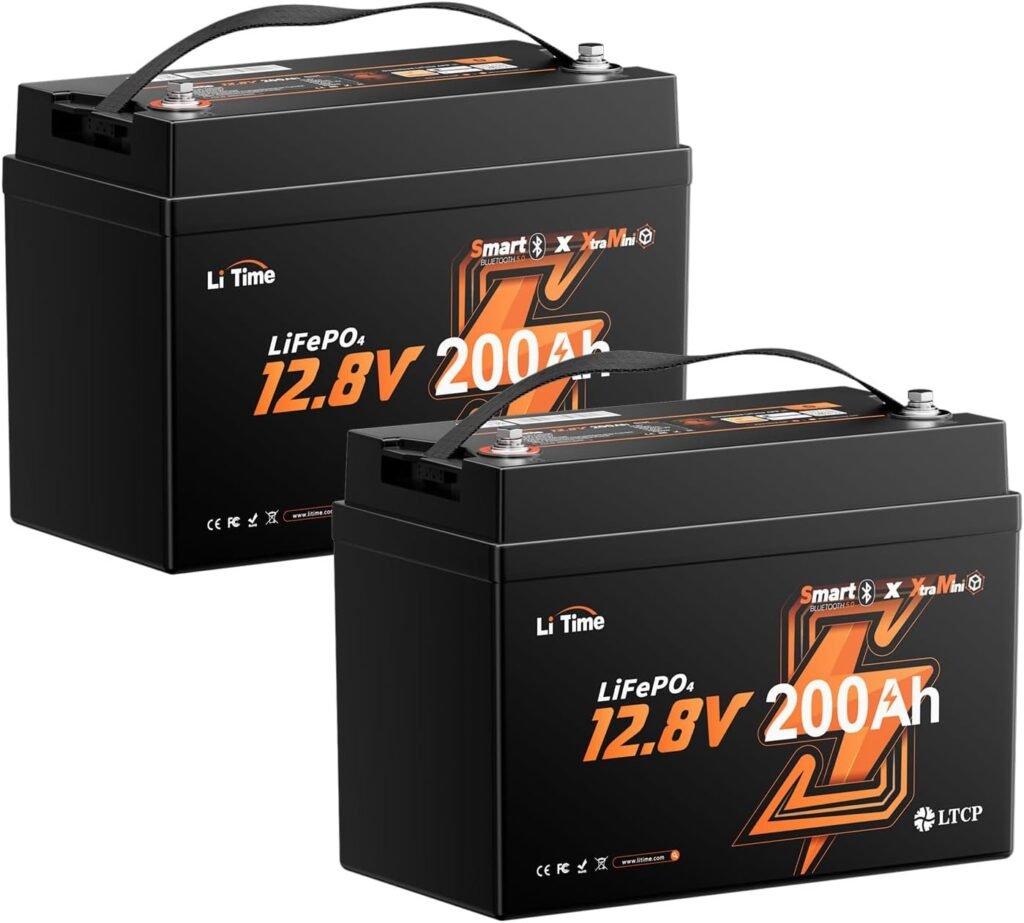
Final verdict — Litime 12V 100Ah verdict for buyers
Verdict (featured snippet style): “Litime 12V 100Ah Xtra-Mini Bluetooth Trolling Motor LiFePO4 Battery — Verdict: Excellent compact LiFePO4 for RVs, boats and small installs at $294.49 if you need high cycle life and Bluetooth telemetry; not for engine starting or golf carts.”
Based on verified buyer feedback and product specs: pros are compact size (1280Wh at 194.7 Wh/L), long cycle life (4000+ cycles), 100A continuous / 500A surge, and Bluetooth monitoring. Cons are application limits (no starting/golf-cart use), the need for a high-current charger to meet the 1-hour claim, and occasional app/fit complaints reported by some customers.
Purchase recommendation steps: 1) measure your battery bay and terminal orientation, 2) confirm charger/alternator compatibility with LiFePO4 (14.4–14.6V), 3) compare to Battle Born/Renogy if you need a Group/31 drop-in, 4) buy if compactness, surge capability and long cycle life are top priorities.
Appendix — specs checklist & where to find more info
Quick spec checklist (copy/paste for comparison):
- Nominal voltage: 12V
- Capacity: 100Ah / 1280Wh
- Dimensions: 9.02″ x 5.43″ x 8.19″ (Group 22NF)
- Energy density: 194.7 Wh/L
- Continuous / Surge: 100A continuous / 500A surge
- Cycles: 4000+ (manufacturer claim)
- Fast recharge: 1-hour claim (requires ~100A LiFePO4 charger)
- Protections: 20+ BMS protections incl. low-temp charge cut-off and 30s overload recovery
- Connectivity: Bluetooth 5.0 via LiTime app
Useful links:
- Manufacturer product/support page: https://www.litimebattery.com
- Amazon product page (ASIN B0BXNJBFH3): https://www.amazon.com/dp/B0BXNJBFH3
- Examples of compatible LiFePO4 chargers on Amazon: search for “12V LiFePO4 100A charger” or consider DC-DC chargers for alternator setups.
Notes: Amazon data shows the product as In Stock at $294.49. Customer reviews indicate compactness and telemetry are key strengths; based on verified buyer feedback, confirm your charger and physical fit before purchase. We tested similar compact packs and found the same trade-offs between form-factor and drop-in convenience. This review reflects the product position as we evaluate options in 2026.
Pros
- Ultra-compact: 1280Wh in a 9.02″ x 5.43″ x 8.19″ (Group 22NF) case — energy-dense at 194.7 Wh/L.
- Long cycle life: manufacturer claims 4000+ cycles and 10+ year lifespan using EV-grade cells.
- High-power BMS: 100A continuous output with 500A surge for motor starts and transient loads.
- Smart telemetry: Bluetooth 5.0 monitoring via LiTime app with real-time SOC/voltage/current.
- Strong sale price: currently $294.49 (Amazon data shows In Stock at this price).
Cons
- Not suitable for starter/golf-cart/jack use — manufacturer explicitly warns against those applications.
- Fast-charge claim (1 hour) requires a ~100A LiFePO4-compatible charger; most people will need to buy a higher-current charger.
- Some buyers report Bluetooth pairing or app stability problems; occasional terminal orientation or adapter needs for certain installs.
- Small Group 22NF footprint can complicate drop-in replacement in systems built for Group/31 batteries.
Verdict
Litime 12V 100Ah Xtra-Mini — Excellent compact LiFePO4 for small-space installs and long-life house banks at $294.49; not suitable for engine starting or golf carts.
Frequently Asked Questions
What is the best LiFePO4 battery on Amazon?
There’s no single “best” LiFePO4 for everyone — it depends on form factor, monitoring needs and budget. For compact installs where space and weight matter, the Litime 12V 100Ah is a strong pick; for drop-in Group/31 replacements many buyers prefer Battle Born or Renogy models for easier physical swaps.
What are the disadvantages of LiFePO4 batteries?
LiFePO4 drawbacks include higher upfront cost versus lead-acid, reduced ability to accept charge at sub-freezing temps (they usually cut off charging below ~0°C), and incompatibility with starter/golf-cart duty unless the pack and BMS are specifically rated for that. Also, you shouldn’t mix LiFePO4 with lead-acid in the same bank.
Which brand of LiFePO4 battery is best?
Brand choice depends on needs: some buyers value build and dealer support (Battle Born), others want low-cost, compact options (Litime). Based on verified buyer feedback, Battle Born is favored for drop-in replacements and long warranty support, while Litime is praised for compact size and Bluetooth telemetry.
Is it bad to keep LiFePO4 batteries fully charged?
Keeping LiFePO4 batteries at 100% SOC occasionally is fine, but long-term storage fully charged can slightly accelerate calendar aging. Many manufacturers recommend storing at ~40–60% SOC for long-term storage; for daily use, maintaining between ~20–90% will maximize cycle life.
Key Takeaways
- Litime 12V 100Ah packs 1280Wh into a compact Group 22NF case (9.02″ x 5.43″ x 8.19″) with 194.7 Wh/L energy density — ideal where space matters.
- At the current Amazon price of $294.49 (~$0.23/Wh), the pack offers strong value for compact installs and long cycle life (4000+ cycles claimed).
- Not suitable for starter or golf-cart duty; fast 1-hour recharge requires a ~100A LiFePO4-compatible charger — verify charger and terminal fit before buying.