When it comes to battery safety, what’s the true measure of a reliable Lithium Iron Phosphate (LiFePO4) system? As we examine the critical safety features embedded within a Battery Management System (BMS), we uncover how precise monitoring and fault detection prevent hazards like thermal runaway and short circuits. Understanding these mechanisms is essential for ensuring longevity and safety, but the real question remains: how do these components work together to protect your investment?
Key Takeaways
- Monitors voltage, current, and temperature to prevent overcharge, overdischarge, and thermal runaway hazards.
- Implements short circuit and overcurrent protection to avoid electrical faults and damage.
- Uses temperature sensors and cooling controls to maintain safe operating temperatures.
- Detects faults in real-time and issues alerts to enable prompt safety interventions.
- Maintains cell balancing and battery integrity to ensure consistent performance and long-term safety.
What Is a Lifepo4 Battery BMS and Why Is It Important?
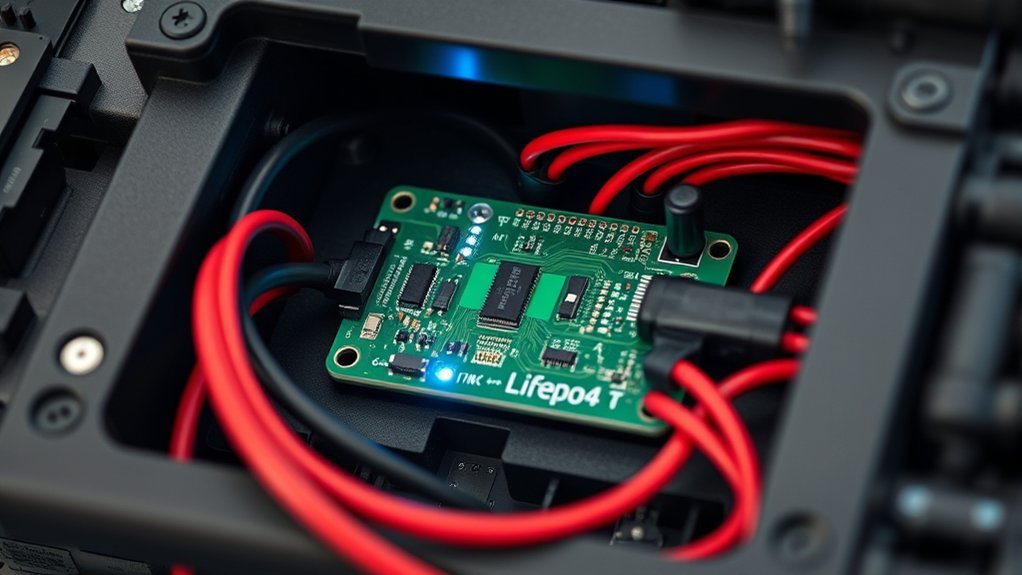
A Lithium Iron Phosphate (LiFePO4) Battery Management System (BMS) is a critical component that monitors and controls the operation of the battery pack to guarantee safety, longevity, and ideal performance. It guarantees optimal functioning by managing battery chemistry parameters, such as voltage, current, and temperature, to prevent issues like overvoltage or thermal runaway. The BMS also verifies charger compatibility, enabling the battery to safely accept charging cycles without damaging the cells. By continuously analyzing cell balancing and state of charge, it maintains uniform voltage levels across all cells, enhancing overall efficiency. This precise regulation minimizes degradation, extends cycle life, and ensures safe operation, making the BMS indispensable for reliable, long-term LiFePO4 battery systems.
How Does Overcharge Protection Keep Your Battery Safe?

Overcharging a LiFePO4 battery can lead to severe safety hazards and accelerated degradation, which is why overcharge protection is an essential function of the BMS. This feature monitors voltage levels during charging, preventing the battery from exceeding its maximum capacity. By doing so, it minimizes risks such as thermal runaway and potential fires. Overcharge protection also promotes proper charger compatibility, ensuring the charging process remains within safe parameters. Additionally, safeguarding against overcharge extends the battery’s lifespan, facilitating more effective battery recycling by reducing the need for premature replacements. The BMS’s precise control maintains ideal voltage thresholds, balancing performance with safety. Overall, overcharge protection is critical for maintaining battery integrity, ensuring user safety, and supporting sustainable battery lifecycle management.
The Role of Overdischarge Prevention in Battery Longevity
Since deep discharges can cause irreversible damage to LiFePO4 batteries, preventing overdischarge is essential for maintaining their longevity. Overdischarge risks lead to capacity loss, increased internal resistance, and potential cell imbalance, compromising overall battery performance. Effective battery capacity management involves the BMS monitoring voltage levels and disconnecting the load once a critical threshold is reached, thereby avoiding damage. This protective measure ensures the battery retains its structural integrity and prolongs cycle life. By actively preventing overdischarge, the BMS preserves the chemical stability of the cathode and anode, which is indispensable for the battery’s durability. In essence, overdischarge prevention is a pivotal component in safeguarding the battery’s long-term reliability and peak function.
Managing Heat: Thermal Protection Features of Lifepo4 BMS
Effective thermal management is critical for ensuring the safety and longevity of LiFePO4 batteries, and the Battery Management System (BMS) plays a pivotal role in this process. The BMS monitors temperature data across cells to prevent overheating, which can compromise performance or cause damage. Thermal protection features activate cooling mechanisms or disconnect the battery if heat dissipation becomes inadequate, maintaining ideal operating temperatures. Efficient thermal management minimizes thermal runaway risks and extends battery lifespan. Advanced BMS designs incorporate temperature sensors and algorithms that precisely regulate heat dissipation, ensuring uniform temperature distribution throughout the pack. By proactively managing heat, the BMS safeguards against temperature-induced failures and preserves the battery’s stability, ultimately enhancing safety and operational reliability.
Preventing Short Circuits: Safety Measures Every BMS Implements
To prevent short circuits, BMSs incorporate overcurrent protection mechanisms that disconnect the circuit under excessive load conditions. Short circuit detection systems continuously monitor for abnormal current flow, enabling rapid response to potential faults. Additionally, proper wiring practices and the use of fuses guarantee that electrical faults are isolated before causing damage or safety hazards.
Overcurrent Protection Mechanisms
Overcurrent protection mechanisms are essential components of a LiFePO4 BMS, actively preventing short circuits that could lead to system failure or safety hazards. These mechanisms monitor current flow during operation, ensuring it stays within safe limits dictated by the battery’s design and charging algorithms. When an overcurrent event occurs, the BMS rapidly disconnects the load or charger, minimizing thermal stress and potential damage. This safeguards battery recycling processes by preventing excessive current that could degrade cell integrity. Precise overcurrent control also optimizes charging efficiency, avoiding unnecessary stress that shortens battery lifespan. By integrating these safeguards, the BMS maintains operational safety, supporting reliable energy management and extending the overall durability of LiFePO4 batteries.
Short Circuit Detection Systems
Have you ever wondered how a BMS can detect a short circuit before it causes serious damage? Short circuit detection relies on rapid current sensing and voltage monitoring across individual cells. When abnormal current surges occur, the system activates protective measures, preventing thermal runaway or damage. This function is vital for safe operation, especially during battery recycling processes or when implementing advanced charging algorithms. Here’s a closer look:
| Detection Method | Response Action | Key Benefit |
|---|---|---|
| Current sensing resistors | Immediate current cutoff | Prevents overheating |
| Voltage imbalance monitoring | Discharges or isolates faulty cell | Maintains cell integrity |
| Temperature sensors | Activates cooling or shutdown | Avoids thermal damage |
| Fault signal processing | Alerts system for diagnostics | Enhances safety protocols |
| Integration with charging algorithms | Adaptive current regulation | Optimizes performance |
These systems guarantee safety, longevity, and reliable operation, integral to responsible battery management.
Proper Wiring and Fusing
Proper wiring and fusing are fundamental to preventing short circuits in battery management systems. Correct wiring ensures that current flows along designated pathways, minimizing risk points that could lead to faults. Fuses serve as protective devices, disconnecting the circuit during overloads or short circuits, which is crucial given the specific battery chemistry of Lifepo4 cells. Proper wiring also supports adherence to charging protocols, preventing conditions that might cause thermal runaway or damage. By integrating fuse ratings aligned with the battery’s maximum current and voltage specifications, we mitigate potential hazards. Additionally, precise wiring reduces resistance and heat buildup, enhancing overall safety. Together, these measures form an essential layer of defense, ensuring the integrity and longevity of the battery system under various operational and fault conditions.
How Cell Balancing Enhances Battery Performance and Safety
Cell balancing plays a crucial role in maintaining ideal battery performance by guaranteeing uniform charge levels across individual cells. Variations in cell chemistry can lead to uneven charge states, which are exacerbated over multiple charging cycles. Without proper balancing, some cells may become overcharged while others remain undercharged, risking capacity loss and potential safety hazards. By equalizing charge among cells, a BMS prevents overdischarge and overcharge conditions, extending battery lifespan. This process also optimizes energy transfer efficiency, as balanced cells deliver consistent voltage and current during operation. Effective cell balancing mitigates the risk of thermal runaway and capacity fade, making it an essential safety feature. Ultimately, it preserves battery integrity and ensures reliable performance throughout numerous charging cycles.
Monitoring Voltage and Current: Key Functions of a Lifepo4 BMS
Monitoring voltage and current is fundamental to ensuring the safe and efficient operation of a Lifepo4 battery management system (BMS). Precise voltage measurement across individual cells enables the BMS to accurately assess battery capacity, preventing overcharge and deep discharge, which directly impacts the longevity and number of charging cycles. Current monitoring during charging and discharging helps detect abnormal flow, safeguarding against thermal runaway or damage. This real-time data supports best balance between cells, maintaining consistent voltage levels. By controlling charge and discharge rates based on voltage and current metrics, the BMS extends battery lifespan and preserves capacity over time. Ultimately, these monitoring functions underpin the battery’s reliability, safety, and performance throughout its operational life.
Why Fault Detection and Alarms Are Critical for Battery Safety
Fault detection and alarms are essential components of a Lifepo4 BMS because they provide immediate alerts when abnormal conditions arise, allowing for swift intervention before minor issues escalate into serious safety hazards. These features directly impact battery lifespan by preventing conditions that cause degradation, such as overvoltage or overheating. They also mitigate environmental impact by reducing the risk of thermal runaway and hazardous leaks.
Key functions include:
- Real-time fault detection to identify issues like overcurrent, undervoltage, or temperature anomalies.
- Alarm systems that notify users instantly, enabling quick response.
- Data logging for diagnostics, aiding preventive maintenance and extending battery longevity.
Together, these safety mechanisms ensure reliable operation and minimize ecological footprint.
Choosing the Right Lifepo4 BMS: Key Safety Features to Consider
When selecting a Lifepo4 BMS, it’s vital to prioritize safety features that effectively prevent hazardous conditions and guarantee reliable operation. Key considerations include robust battery packaging, which guarantees physical and thermal protection against mechanical stresses and temperature fluctuations. The BMS should incorporate advanced charging protocols that limit voltage and current to prevent overcharging and thermal runaway. These protocols also optimize cell balancing, extending battery lifespan and maintaining consistent performance. Additionally, a thorough BMS should include fault detection mechanisms for short circuits, overcurrent, and temperature anomalies, coupled with alarms to alert users promptly. Proper integration of these safety features ensures the battery operates within safe parameters, minimizing risks and enhancing overall system reliability.
Frequently Asked Questions
How Does a BMS Prevent Thermal Runaway in Lifepo4 Batteries?
We prevent thermal runaway by implementing advanced fault prevention and thermal management strategies, such as temperature monitoring and balancing. This guarantees the battery maintains safe operating ranges, detects anomalies early, and automatically reduces or cuts off power to avoid hazards.
Can a BMS Protect Against Physical Damage or Impacts?
A BMS primarily monitors electrical parameters, so it offers limited protection against physical damage or impacts. While impact-resistant enclosures help mitigate physical damage, the BMS’s role is to prevent electrical failures, not absorb physical shocks.
What Are the Safety Features for Electrolyte Leakage Detection?
We implement electrolyte monitoring and leakage prevention in our BMS to detect early signs of electrolyte leakage. These safety features actively monitor electrolyte levels and isolate affected cells, ensuring system integrity and preventing potential hazards caused by electrolyte leakage.
How Does a BMS Handle Fault Diagnosis and Recovery?
Like skilled surgeons, we conduct fault detection meticulously, pinpointing issues precisely. Our BMS then initiates system recovery protocols, isolating faults quickly, ensuring safety, and restoring ideal battery performance through advanced diagnostics and automated corrective actions.
Are There Specific Safety Certifications for Lifepo4 BMS Units?
We find that specific safety certifications for LiFePO4 BMS units, like UL or IEC standards, validate battery management safety protocols. These certifications guarantee rigorous testing, promoting reliable fault detection, prevention, and overall safety in diverse operational environments.
Conclusion
In ensuring the safety and longevity of LiFePO4 batteries, understanding these BMS features is essential. Do we truly grasp how overcharge protection, thermal management, and fault detection work together to prevent hazards? By selecting a BMS with thorough safety measures, we can optimize performance while minimizing risks. After all, isn’t safeguarding our energy investments and ensuring operational integrity worth meticulous attention to these critical safety features?