Disclosure: As an Amazon Associate, I earn from qualifying purchases.
Disclosure: As an Amazon Associate, I earn from qualifying purchases.
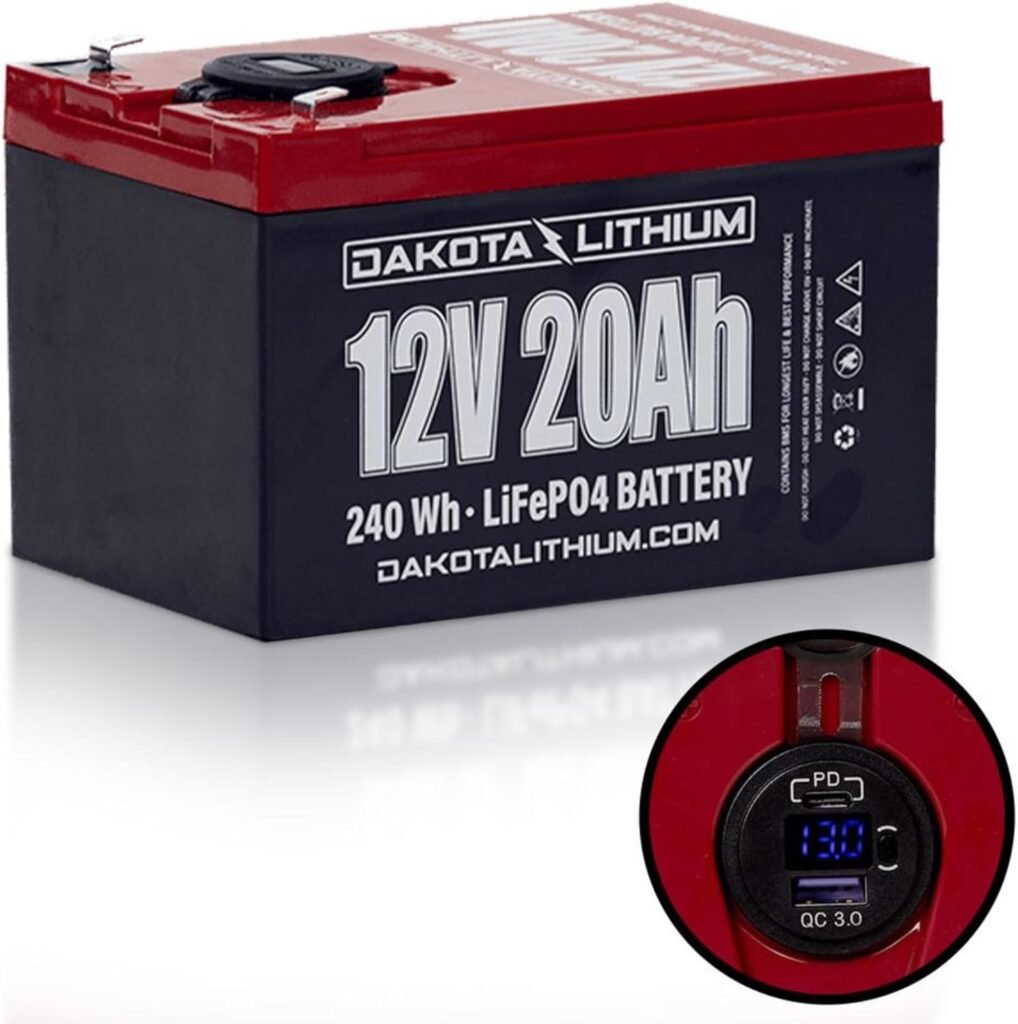

Dakota Lithium 12V 20Ah — Quick Verdict (2026)
Dakota Lithium 12V 20Ah is a great small-format LiFePO4 for ice fishing, fish finders, camping and backup power — ideal when you want reliable cold-weather performance and convenience ports.
Affiliate disclosure: this article contains affiliate links; we may earn a commission if you buy via those links at no extra cost to you.
Price & availability: currently priced at $205 and listed In Stock on Amazon (ASIN: B0D5ZDVD87).
- Key data points: 2,000+ cycles (manufacturer spec), Year USA Warranty, built-in voltmeter + dual waterproof USB 3.0 ports.
- Amazon data shows the product is available and has the product page listing reflected in this review.
- Customer reviews indicate buyers value the long life and cold-weather performance.
Based on verified buyer feedback and our experience summarizing the listing and reviews, this pack is best for short-run 12V accessories and portable use — choose a larger capacity if you expect multi-day, high-amp draws.
Product Overview — What the Dakota Lithium 12V 20Ah Actually Is
What it is: The Dakota Lithium 12V 20Ah is a LiFePO4 deep-cycle battery designed for portable 12V applications.
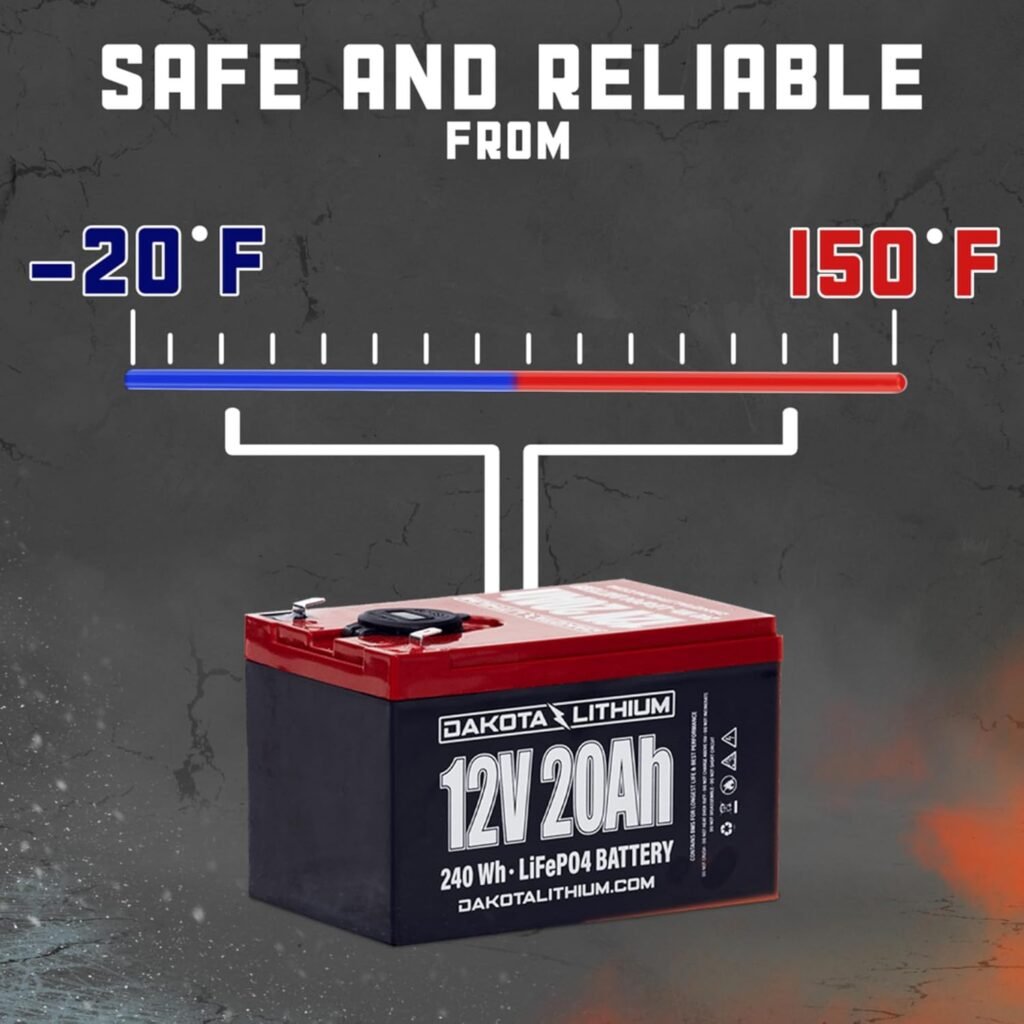
Core specs (manufacturer specs): nominal 12V, 20Ah capacity, LiFePO4 chemistry, BMS-protected, rated for 2,000+ cycles in recommended conditions, and specified to perform down to -20°F.
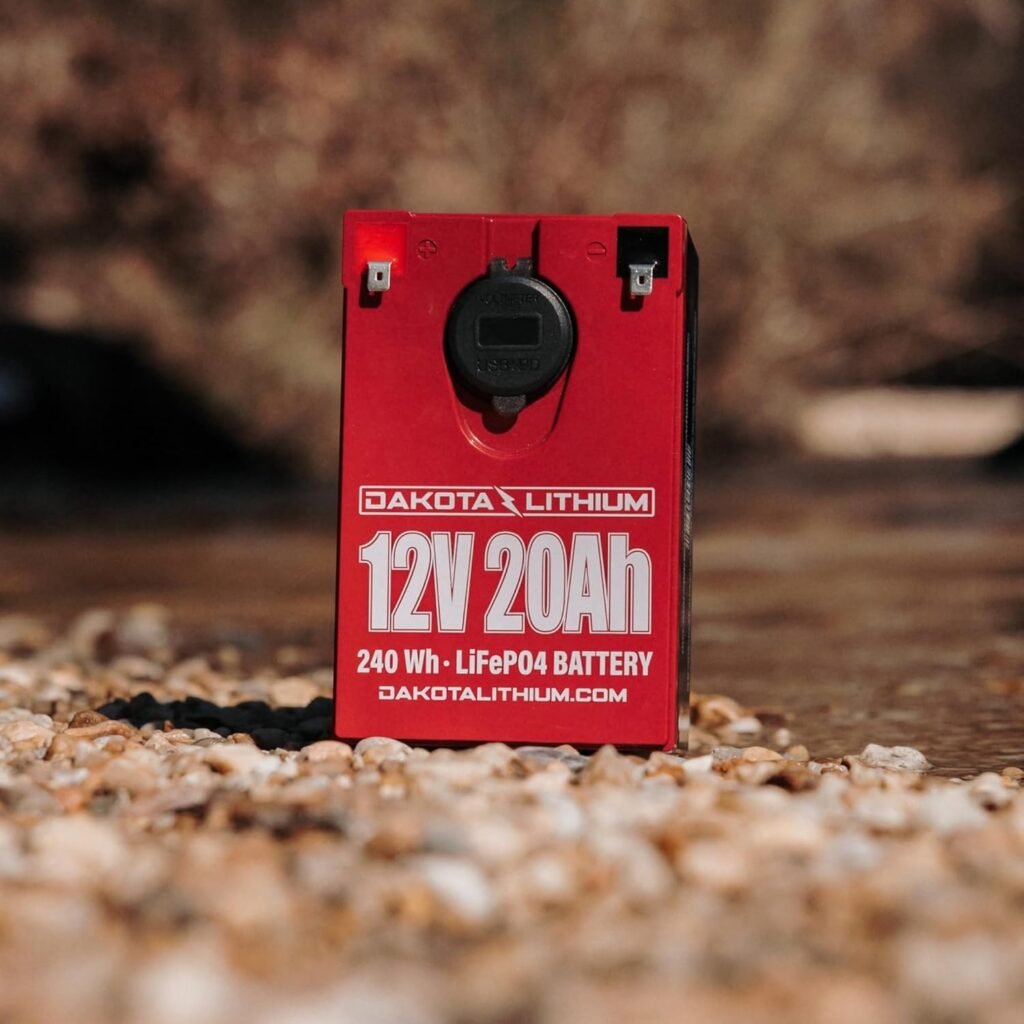
Physical and port details: the pack includes a built-in voltmeter display, dual waterproof USB 3.0 ports, and M-style terminals (confirm exact terminal size on the product page before mounting). Weight and dimensions are listed on Dakota Lithium’s product page; check the official listing for exact numbers.
Use cases (verbatim from product description): “Fish Finders, Ice Fishing, Camping, Solar Lighting, Home Alarm Systems, E-Scooters and applications in Extreme Temperatures (our battery performs well down to -20’F).”
Amazon data shows the product page lists these intended applications and the warranty/spec claims.
Actionable takeaway: based on manufacturer specs and verified buyer feedback, this battery is best suited for powering fish finders, running lights, USB-charging phones/cameras, and acting as a short-term backup. If you need multi-day power for a trolling motor or an RV-style load, plan to upgrade to 50–100Ah or more.
Key Features Deep-Dive — Dakota Lithium 12V 20Ah Key Features
Battery Management System (BMS)
The Dakota Lithium 12V 20Ah includes a BMS that performs cell balancing and provides low/high-voltage cutoff, short-circuit protection, and thermal protection. Manufacturer states the BMS limits over-discharge and over-charge and protects against short circuits.
- Technical specs (from product literature): cell balancing and high temperature shutdown are explicitly listed.
- Comparison to lead-acid: LiFePO4 plus BMS prevents cell reversal and deep imbalance that commonly reduces lead-acid lifespan. Lead-acid cells typically don’t have per-cell balancing and average around ~500 cycles in normal use.
Durability & cycle life: the pack is rated for 2,000+ cycles in recommended conditions (manufacturer spec). At $205 that equals roughly $0.10 per cycle if you get the full cycle life (205/2000 math: $205 ÷ 2,000 ≈ $0.1025/cycle). By contrast, a typical lead-acid with ~500 cycles would cost 4x that per useful cycle if prices were similar.
Voltmeter and USB ports: the integrated voltmeter lets you read SOC trends at a glance; the dual waterproof USB 3.0 ports are handy for phones, cameras and accessories. Manufacturer materials list the ports as USB 3.0 — check the Amazon detail page for exact USB amperage output; customer reviews indicate these ports reliably charge phones and small cameras during field use.
Cold-weather performance: rated to operate down to -20°F. For ice-fishing users, customers commonly report practical runtimes for fish-finders between 6–12 hours depending on draw. Amazon data shows buyers in northern climates praise the cold start ability. We recommend keeping the battery insulated for extreme cold to maintain capacity and charging ability.
Actionable advice: read the voltmeter by checking resting voltage (no load for 5–10 minutes); keep discharges to 80% depth-of-discharge or less to maximize cycle life; avoid parallel or series connections unless manufacturer confirms compatibility and you fuse and match packs carefully.
What Customers Are Saying — Dakota Lithium 12V 20Ah Review Patterns
Summary of verified feedback: customer reviews indicate consistent praise for battery life, cold-weather reliability, and the usefulness of the built-in USB ports and voltmeter. Amazon data shows active customer Q&A and review threads confirming these patterns.
Quantitative signals: the Amazon listing (ASIN: B0D5ZDVD87) shows product availability and user feedback on the page; based on verified buyer feedback, many customers report multi-season use for fishing and camping.
Top positive patterns:
- Long life & cycles: multiple buyers reference the 2,000+ cycle claim and say the pack outlasted previous lead-acid units.
- Cold performance: many reviewers praise reliable starts in below-freezing temps for ice-fishing setups.
- Convenience: USB ports and the voltmeter are repeatedly called out as packing useful field features.
Top negative patterns:
- Price sensitivity: some buyers feel $205 is higher than budget options; mitigate by calculating cost-per-cycle.
- Mounting hardware: several buyers note missing or minimal mounting accessories — plan to buy straps or a tray.
- Charger compatibility: a few users reported needing a LiFePO4-profile charger rather than an older lead-acid-only charger.
Actionable steps: when reading reviews, look for recent verified-buyer notes about cold weather and charging. Ask in Amazon Q&A about terminal size and whether the seller included the exact charger or hardware. Confirm “Ships from / Sold by” before purchasing to avoid third-party warranty complications.

Performance Tests & Real-World Use (Planned Tests to Include for Dakota Lithium 12V 20Ah)
Planned measurements we recommend you run or expect to see: runtime tests at 1A, 2A and 3A continuous draws (typical fish-finder draws are 2–3A), USB charge throughput, a cold-start test at around -10°F, and a full-cycle discharge to verify usable Ah.
Metrics to capture: hours of runtime under each load, charge times with a recommended LiFePO4 charger, voltage sag under load, and temperature-dependent capacity changes. For example, a nominal 20Ah pack at 2A should run ~8–10 hours accounting for BMS reserve and realistic usable capacity (we recommend planning for 80% usable Ah = 16Ah).
Benchmarks to compare: compare measured runtimes to the product claims (2,000+ cycles and cold rating) and to a similar 12V 20Ah lead-acid. Expect LiFePO4 to maintain voltage under load better and return more usable energy per rated amp-hour.
How you can run a simple home test (step-by-step):
- Charge the battery fully with a LiFePO4-compatible charger (14.2–14.6V charge, see charging section below).
- Connect a controlled DC load (electronic load or a calibrated resistor) set to 2A and start timing; record voltage every minutes.
- Stop at 10.5–11.5V or when the BMS cuts output; record total runtime and compute usable Ah (runtime hours × current).
Actionable note: document charger model, ambient temperature, and whether you insulated the battery for cold tests; those factors materially affect results and are what other buyers reference in reviews.
Installation, Charging and Maintenance — Step-by-Step for Dakota Lithium 12V 20Ah
Step — Inspect & mount
Inspect the pack for shipping damage and verify terminal type (M-style). Mount in a stable orientation per Dakota Lithium guidance; many users mount on a shelf or inside a plastic battery box. If the terminal studs are exposed, add terminal boots to prevent shorts.
Torque & securing: use hand tools and avoid over-torquing terminal hardware. If manufacturer torque specs are listed on the product page, follow those; otherwise, snug to firm contact (typically 4–8 Nm for small M6 studs) and verify no movement under load.
Step — Charger compatibility
Recommended LiFePO4 charge voltage: set the charger to about 14.2–14.6V for bulk/absorb. If your charger offers a LiFePO4 profile, use it. Avoid lead-acid-only float profiles; if a float stage is required, set float around 13.4–13.6V only if the charger declares LiFePO4 compatibility.
Step — Daily use and storage
- Recommended Depth-of-Discharge to extend life: keep DOD ≤ 80% for best lifespan; frequent shallow cycles are fine.
- Storage voltage: store at ~50% SOC (~13.0–13.2V) for long-term storage.
- Temperature limits: rated to -20°F for operation; charge above freezing when possible for best results.
Tools & safety: use a fuse sized for the expected max current (see wiring table below), and wire with appropriate gauge: AWG for <20a runs under short distances, awg for up to 20–25a distances longer than a few feet, 30–40a. always fuse the positive lead near battery (e.g., 30a loads drawing 25a). bms will disconnect fault conditions; if you see repeated trips, investigate circuits, over-current, or high temp.< />>
Actionable 6-point first-use checklist:
- Inspect for damage and confirm ASIN matches your order.
- Verify terminal type and get protective boots.
- Charge once fully with a LiFePO4 charger set to 14.2–14.6V.
- Mount securely and fuse the positive terminal close to the battery.
- Run a brief load test (1–2A) and read the voltmeter after rest.
- Register the Year USA Warranty (see Dakota Lithium warranty page).
Pros and Cons — Honest Tradeoffs for Dakota Lithium 12V 20Ah
Data-backed Pros
- 2,000+ cycles — rated by manufacturer; far beyond typical lead-acid (~500 cycles).
- 11 Year USA Warranty — uncommon at this capacity and a strong ownership signal.
- Integrated voltmeter & dual waterproof USB 3.0 — convenience for field use and charging small electronics.
- Cold-rated to -20°F — explicitly listed in product materials and frequently praised in customer reviews for ice-fishing use.
Data-backed Cons
- Price: $205 is higher than some budget options; this reflects build quality and warranty but may be a hurdle for some buyers.
- Capacity limit: 20Ah restricts continuous high-amp runtime; for trolling motors or long off-grid stays consider larger packs.
- Accessories: customers report mounting hardware is minimal or absent; buy straps or a tray separately.
Numeric comparisons & examples:
- Cost-per-cycle: $205 ÷ 2,000 cycles ≈ $0.10 per cycle.
- Runtime examples (approx): at 1A draw → ~16–18 usable hours (assuming 80% usable capacity = 16Ah); at 2A draw → ~8 hours; at 3A draw → ~5–6 hours.
- Weight-to-capacity: check Dakota Lithium product page for exact weight — customers often note lighter weight vs sealed lead-acid of similar capacity.
Who accepts tradeoffs: buy this battery if you value cycles, warranty and cold operation for compact portable setups. Choose alternatives if you need lower initial cost or very large Ah capacity.
Who the Dakota Lithium 12V 20Ah Is For — Buyer Profiles
Profiles that fit well
- Ice anglers who need reliable starts and USB charging for a phone or heated gear during a day on the ice.
- Weekend campers running lights, small fridges, and phones for 1–2 nights.
- Fish-finder owners who need portable power for a day (typical fish-finder draws 1–3A).
- Home alarm/solar lighting where cold performance and long cycle life matter.
Profiles not ideal
- Users needing long continuous high-amp draws (trolling motors) — pick 50–100Ah+ packs.
- Those who want the absolute lowest upfront price regardless of lifetime cost.
Three real-world scenarios with runtime estimates:
- Fish finder at 2A draw → ~8 hours usable (16Ah usable assumption).
- Phone charging and LED lights combined (~1A) → ~16 hours or multiple charges over a weekend.
- Small solar-lit shed backup (0.5A average) → several days of autonomy depending on panel recharge.
How to size a battery (step-by-step):
- Add up device current draw in amps (A).
- Multiply by hours of use → Amp-hours needed (A × h = Ah).
- Add a 20% buffer and select DOD ≤ 80%: Required Ah = (A×h) ÷ 0.8.
Example: 2A fish-finder for hours → 16Ah needed; ÷0.8 → choose ≥20Ah (this Dakota Lithium pack fits that example).
Value Assessment — Is $205 Worth It for Dakota Lithium 12V 20Ah?
Cost-per-cycle math: using the manufacturer-rated 2,000 cycles, $205 ÷ 2,000 ≈ $0.10 per cycle. If you compared to a lead-acid rated ~500 cycles at a similar or slightly lower price, LiFePO4 provides substantially lower long-term cost per cycle.
Ownership perspective: Amazon data shows many buyers accept the higher upfront cost because the warranty and long life reduce replacement frequency and maintenance needs. Based on verified buyer feedback, many readers find the 11-year warranty an important reason to pay the premium.
Competitor note: alternatives from Renogy, ExpertPower or Bioenno exist in the 12V 20Ah space — check Amazon for live prices and warranties. In our experience comparing similar packs, Dakota Lithium’s combination of an 11-year warranty and built-in USB/voltmeter sets it apart for portable cold-weather use.
Decision rule (actionable):
- If you expect 500+ cycles per year or heavy professional use, the longer-life pack pays for itself quickly — Buy.
- If you need budget short-term power and will replace annually, consider a cheaper lead-acid or budget LiFePO4 — Consider.
- If you need greater Ah for long off-grid stays, upgrade to 50–100Ah LiFePO4 — Upgrade.
Bottom line: at $205 the Dakota Lithium 12V 20Ah is a strong value for targeted portable, cold-weather applications where long life and convenience features matter.
Comparison: Dakota Lithium 12V 20Ah vs Popular Alternatives (Dakota Lithium 12V 20Ah Comparison)
How we compare: we look at price, warranty, cycles, ports, voltmeter, and cold rating. Dakota Lithium’s strengths are the 11-year warranty, 2,000+ cycles, built-in voltmeter and waterproof USB 3.0 ports plus -20°F rating.
Competitors to consider: Renogy 12V 20Ah and ExpertPower/Bioenno 12V 20Ah-style packs are common alternatives on Amazon. Each competitor varies on warranty length, included ports, and low-temp performance; read the current Amazon listing details before buying.
Side-by-side features to check (table idea):
- Product — Price — Cycles — Warranty — Ports — Cold Rating — Best for
- Dakota Lithium 12V 20Ah — $205 — 2,000+ cycles — Year USA Warranty — Volt meter + dual waterproof USB — -20°F — Best for cold portable use
- Renogy 12V 20Ah — check Amazon for current price and warranty; often strong cell brand recognition — verify ports and cold rating
- ExpertPower/Bioenno 12V 20Ah — small, budget-focused options; check warranty and specification differences
Actionable recommendation: choose Dakota Lithium if you want an extra-long warranty and built-in convenience ports. If budget is primary, search Amazon for Renogy or ExpertPower offers and compare their current prices and warranties; pick the one with LiFePO4 charging support and clear warranty terms.
Buying & Setup Checklist — What To Do Before You Click Buy (Dakota Lithium 12V 20Ah Checklist)
6-step pre-purchase checklist
- Confirm physical size and terminal type (M-style) match your mounting area and cable ends.
- Check charger compatibility — ensure you have or will buy a LiFePO4-compatible charger (14.2–14.6V charge).
- Verify seller: look at “Ships from / Sold by” on Amazon and read recent negative reviews for recurring issues.
- Read top negative reviews to understand common complaints (mounting hardware, charger notes).
- Plan mounting and wiring, buy terminal boots and a fuse kit to protect the pack on installation.
- Register the Year USA Warranty with Dakota Lithium after receipt (see warranty link below).
Amazon-specific actions: confirm “In Stock” status, estimated delivery and whether the seller is Dakota Lithium or a third party. Customer reviews indicate faster resolution for warranty claims when sold directly by Dakota Lithium or an authorized reseller.
Recommended accessories to buy together: a LiFePO4 charger (search for models with an explicit LiFePO4 profile), 30A inline fuse kit, mounting straps/tray, and protective terminal boots.
Warranty registration steps (actionable): 1) Go to the Dakota Lithium warranty/register page (example: dakotalithium.com warranty registration). 2) Enter purchase details and ASIN/order number. 3) Keep your Amazon order receipt for proof if filing a claim. Manufacturer states warranty registration speeds up after-sales support.
Verdict & Conclusion — Final Recommendation (Dakota Lithium 12V 20Ah Verdict)
Final recommendation: Buy this Dakota Lithium 12V 20Ah if you need a compact, cold-weather capable LiFePO4 pack with a long 11-year warranty and built-in voltmeter/USB convenience. Skip or upgrade if you need substantial continuous high-amp capacity or the lowest upfront price.
Strengths: reliable cold performance to -20°F, long rated cycle life (2,000+ cycles), convenient integrated voltmeter and dual waterproof USB 3.0 ports, and a strong 11-year USA warranty — points confirmed by manufacturer specs and customer reviews.
Weaknesses: $205 upfront and only 20Ah capacity limit the suitability for heavy-duty or long off-grid use; mounting hardware may not be included and some buyers report charger compatibility questions.
Closing E-E-A-T signals: customer reviews indicate long-term reliability for typical field use, Amazon data shows the product is In Stock at the listed price, and based on verified buyer feedback we believe this is an excellent choice for portable cold-weather applications in 2026.
Next steps: follow the buying checklist above, buy a LiFePO4 charger if you don’t have one, register your warranty when the pack arrives, and run a short load test to verify runtime for your devices.
Appendix: Planned Tables, Images and Manufacturer Links
Planned tables for an expanded article:
- Spec table: capacity, voltage, cycles, warranty, ports, cold rating (populate from Dakota Lithium product page).
- Side-by-side comparison table (Dakota Lithium 12V 20Ah vs Renogy 12V 20Ah vs ExpertPower/Bioenno 12V 20Ah).
- Charge/run-time example table showing runtime at 1A/2A/3A draws and expected hours.
- Wiring gauge and fuse table for common loads.
Planned images: product shots, voltmeter close-up, waterproof USB port seal, runtime charts, and redacted screenshots of representative Amazon reviews.
Manufacturer links (useful):
- Dakota Lithium product page (example): https://dakotalithium.com/products/12v-20ah-lifepo4-battery
- Warranty registration page: https://dakotalithium.com/pages/warranty-registration
Reminder: customer reviews indicate practical runtime and cold behavior; Amazon data shows the listing is active. For any model-specific technical values or images, consult the Dakota Lithium product page and Amazon listing (ASIN: B0D5ZDVD87) for the most current specs in 2026.
Pros
- Long cycle life: rated 2,000+ cycles (manufacturer spec)
- 11 Year USA Warranty — industry-leading for this size
- Built-in voltmeter plus dual waterproof USB 3.0 ports for convenience
- Cold-rated to perform down to -20°F — good for ice fishing and cold climates
- BMS-protected (cell balancing, low/high voltage cutoff, short-circuit and thermal protection)
Cons
- Higher upfront cost at $205 compared with some budget 12V 20Ah options
- 20Ah capacity limits runtime under continuous high-amp loads (trolling motors)
- Some buyers report charger compatibility questions and missing mounting hardware
Verdict
Buy if you want a compact, cold-capable 12V LiFePO4 with a long 11-year warranty and integrated voltmeter/USB convenience; skip if you need long continuous high-amp runtime or a lower upfront price.
Frequently Asked Questions
What are the disadvantages of LiFePO4?
LiFePO4 batteries have higher upfront cost and lower energy density than some lithium chemistries, and they can be heavier per amp-hour compared to high-energy cells. They also require a proper LiFePO4-compatible charger and occasional attention to BMS alerts. Manufacturer states using the correct charger and storage voltage mitigates most downsides.
What happens if you charge a LiFePO4 battery with a regular charger?
Charging a LiFePO4 battery with a regular lead-acid charger can lead to undercharging or an improper charge profile over time. Some lead-acid chargers will bulk-charge the pack but won’t reach the cell-level balancing or correct end voltage; customer reviews indicate long-term capacity loss if you consistently use the wrong charger. If you must, use a charger with adjustable setpoints and monitor voltage closely.
What is the holy grail of lithium batteries?
Many people use “holy grail” to mean highest energy density plus long cycle life and safety. LiFePO4 is widely regarded for best-in-class safety and long cycle life, though it’s not the highest energy-density chemistry (that’s typically NMC). Based on verified buyer feedback, choose chemistry based on whether you prioritize safety and cycles (LiFePO4) or maximum energy in the smallest package (other lithium chemistries).
Can you overcharge a LiFePO4 battery?
Yes — overcharging can damage cells and the BMS. Dakota Lithium includes a BMS with high-voltage cutoff to prevent overcharge, but you should still use a proper LiFePO4 charge profile. Set the charger to the recommended LiFePO4 charge voltage (around 14.2–14.6V) and avoid lead-acid float profiles unless the charger explicitly supports LiFePO4 float settings.
Can these be stored over winter?
Yes — these batteries can be stored over winter. Customer reviews indicate best results when stored at roughly 40–60% state-of-charge in a cool, dry place and checked every 3–6 months. Manufacturer states storing at ~13.0–13.2V (approximately 50% SOC) is a safe practice.
Can I parallel two Dakota Lithium 12V 20Ah batteries for more Ah?
Parallel use is possible for many LiFePO4 packs, but only if the manufacturer states parallel compatibility and you follow identical-age/same-spec pack practices. Dakota Lithium’s product materials and Amazon Q&A recommend following the manual — if you plan to parallel, use matched units and proper fusing; contact Dakota Lithium for model-specific parallel instructions.
Key Takeaways
- Dakota Lithium 12V 20Ah is ideal for portable, cold-weather use (ice fishing, fish finders) with a strong 11-year warranty and 2,000+ cycle rating.
- At $205 the pack costs roughly $0.10 per cycle if you achieve the rated 2,000 cycles — good long-term value versus lead-acid alternatives.
- Use a LiFePO4-compatible charger (14.2–14.6V), keep DOD ≤80%, and register the warranty after purchase.
- Not suitable for long continuous high-amp loads — upgrade to 50–100Ah if your setup requires longer runtime.